
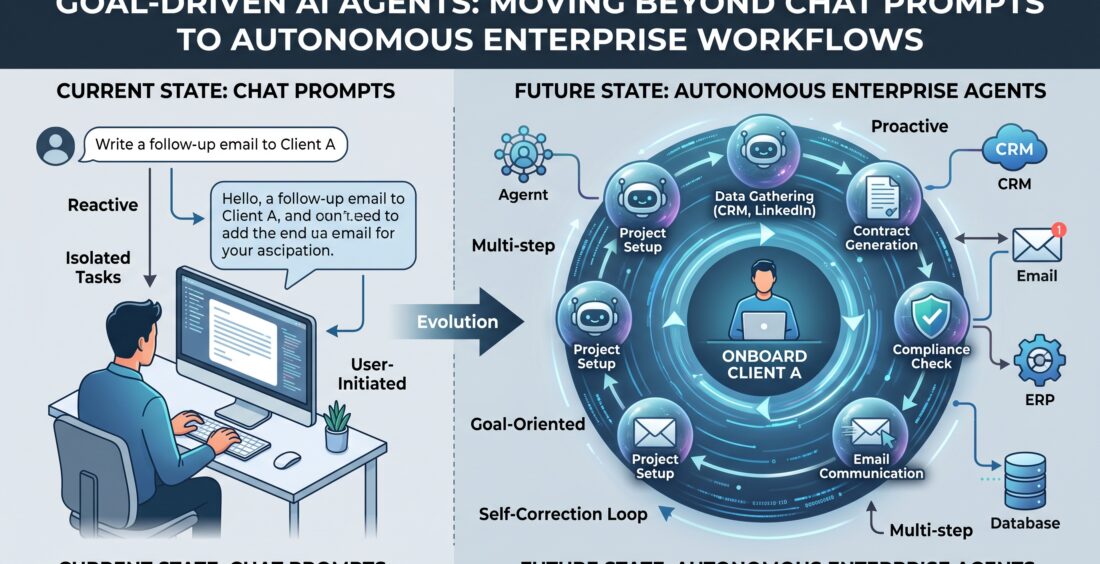
Over the past two years, the corporate world has been obsessed with chat windows and prompt engineering. Almost every industry adopted conversational tools in their internal portals, trained employees to formulate prompts, and waited for the productivity gains to pour in. While prompt-based interaction has proven effective for content generation and document summarization, it has shown to have very limited utility for actual business operations.
The very nature of prompt-based AI is that human operators are the ones orchestrating all processes. If an employee needs to perform an involved business process that spans several operational systems, they have to manually extract the required data from a CRM, paste it in a prompt window, wait for the language model to generate the necessary text, and then type it in an ERP or another business portal. The language model is simply a smart text generator, while humans have to do all the actual work.
This limitation has prompted a shift towards autonomous agentic operations. Instead of designing applications around the idea of a human prompting the AI or writing deterministic code, modern enterprises use goal-driven software. Instead of telling the model to “Write an email to supplier X and ask them to clarify the cause of the last shipment delay,” the delegating software would issue a strategic directive like “Resolve the component shortage in Assembly Line 3 with the most cost-effective available logistics options.”
How Does the Agentic Infrastructure Work?
To understand the agentic paradigm, it is helpful to think about how enterprise applications have traditionally worked. Most business systems use deterministic If-This-Then-That rules. If a specific action occurs, the software will perform a series of scripted operations to address it. However, such a design approach has limitations. If an external API call from the enterprise software fails due to an unplanned third-party server error or an edge case not covered by the developers, the entire process grinds to a halt, and humans have to step in and fix the issue.
An autonomous agent, on the other hand, can handle unexpected occurrences and have more flexibility in performing their tasks. When given a high-level business goal, agentic applications break it down into smaller, achievable tasks, consult external databases to check the relevant contextual variables, and use appropriate APIs to perform required actions.
If the primary logistics portal returns an error in the middle of an autonomous agent’s execution cycle, the software will not fail. Instead, it will use alternative shipping options available in the system to keep the production process running.
How Does Prompt-Based Interaction Differ From Agentic Workflows?
The shift from prompt-based interaction to agentic operations transforms the very nature of humans’ work. When the AI handles all the involved systems’ data management, analytics, and initial decision-making, human operators become strategic supervisors.
Let’s say, for example, that a company’s supply chain manager wants to ensure that their regional distribution centers’ inventory levels are sufficient to meet the anticipated demand. In a prompt-driven setup, the manager would have to manually analyze the inventory data from all the warehouses, identify which ones are low on certain products, and send purchase requests to suppliers. In the agentic paradigm, autonomous agents would monitor the inventory levels in real-time, alert the manager when there is a risk of an imminent stockout, and start contacting suppliers to secure product availability. The manager’s role changes from a hands-on executor to a strategic supervisor, only intervening when the agentic systems need guidance or approval to proceed with higher-level business decisions. Organizations can work with AI Agent development companies to benefit from the agentic paradigm and transform their business processes.
How to Design Autonomous AI Agents Around Business Goals?
When implementing autonomous agents, enterprises have to carefully consider their risk management framework. The most common agentic risk stems from the systems’ inability to properly follow high-level directives. Most often, it happens when the autonomous agents optimize for a specific business metric without considering other relevant variables.
For example, an agent that only has to resolve the shipping delay for a particular order might choose the fastest but prohibitively expensive shipping method, which would eliminate any profit from the sale. Another frequent agentic risk occurs when the autonomous agents process external communications. If the external API call includes additional instructions in the prompt, the language model might inadvertently follow them and start leaking sensitive data to unauthorized third parties.
To reduce the risks of autonomous AI agents, enterprises should implement additional safeguards, such as requiring human operators to confirm all high-level decisions and use additional verification tools to ensure that the prompts sent to the language models only include the intended instructions. By combining the agentic paradigm with enterprise-grade security measures, organizations can maximize the efficiency gains from autonomous AI agents. In the future, the corporate world will no longer focus on prompt engineering but rather on strategically designing business goals for autonomous agents to follow.
Contributed by Guestposts.biz
Further Reading: Cyber Gear Thought Leadership Series







Comments are closed.