
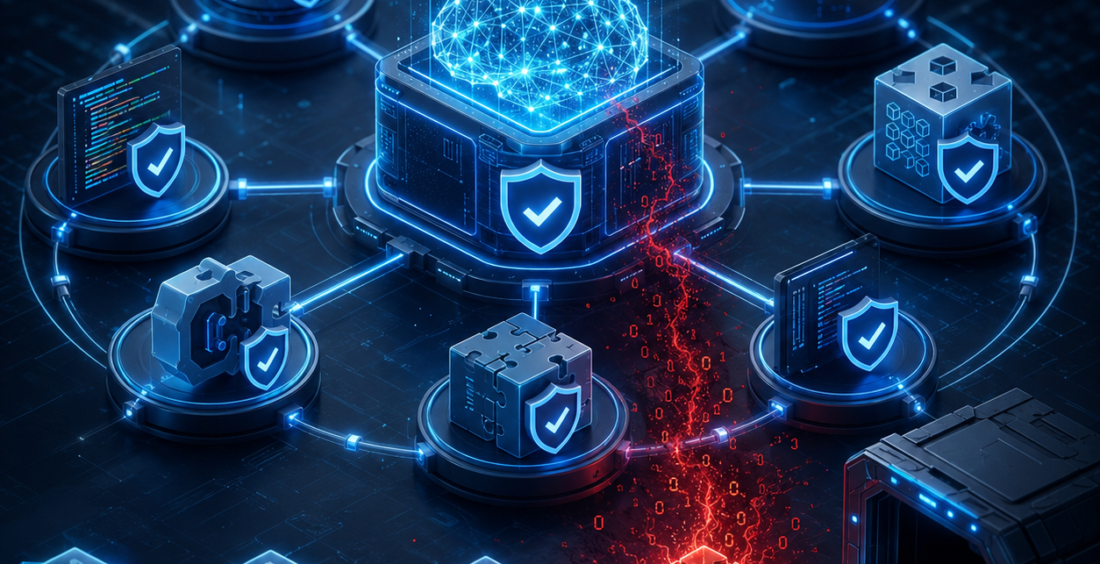
AI model supply chain security is becoming a real cybersecurity concern as companies build products with models, datasets, libraries and tools they did not create themselves.
That is normal. Few organizations train every model from scratch. Teams download open models, connect external services and reuse existing components because it saves time.
The risk is that trust can travel with those components. If a model, dataset or dependency has been tampered with, the problem can enter the business before anyone notices.
AI Has a Supply Chain Too
People usually associate supply chain attacks with software updates or third-party vendors. AI systems have a similar chain.
A typical AI application may depend on a foundation model, training or fine-tuning data, open-source libraries, plugins, APIs and infrastructure from several providers.
Each piece becomes part of the final system.
OWASP warns that data and model poisoning can introduce vulnerabilities, backdoors or unwanted behavior during training and fine-tuning.
That means security cannot begin only after an AI application goes live.
A Model Can Look Safe and Still Be Changed
Downloading a model can feel similar to installing a trusted software package. The difference is that models are large, complex files whose behavior is not always obvious from a quick inspection.
A compromised model could contain hidden behavior that appears only when certain inputs are used. A malicious file could also exploit weaknesses in the tools used to load or process it.
This does not mean public models are unsafe by default.
It means organizations should know where models came from, verify their integrity and avoid treating popularity as proof of security.
Training Data Can Be Poisoned Too
The model is only part of the picture.
AI systems learn from data, and attackers may try to influence that data. A poisoned dataset can introduce misleading patterns, unsafe responses or hidden triggers that affect later behavior.
The risk becomes more practical when companies fine-tune models using information gathered from customers, websites or external partners.
If nobody checks the source or quality of that data, attackers may have a chance to shape what the system learns.
Data security is therefore part of model security.
Dependencies Can Create Quiet Weaknesses
AI projects often rely on familiar software packages for data processing, model serving, authentication and deployment.
A vulnerable dependency can create risk even when the model itself is fine.
This is why traditional software security still matters. Teams need to track libraries, patch known vulnerabilities and understand which components are actually running in production.
CISA published minimum elements for software bills of materials for AI in 2026, extending the idea of an ingredients list to AI systems.
Visibility makes it easier to answer a basic question: what are we actually using?
Third-Party Models Need Vendor Questions
Businesses increasingly access AI through hosted services rather than downloading models directly.
That shifts some responsibility to the provider, but it does not remove risk.
Companies should ask how models are updated, how training data is handled, whether security issues are disclosed and how quickly vulnerable components are replaced.
They should also understand what happens when a provider changes the model behind an existing service.
A system can behave differently after an update even if the business did not change its own code.
Keep a Record of What Changes
AI systems can evolve quickly.
Models are replaced, prompts are updated, datasets change and new tools are connected. Without a record, security teams may struggle to explain why an application started behaving differently.
Version control and change tracking help.
Organizations should know which model version is running, which data sources it uses and who approved major changes.
That information becomes especially important during an incident.
If something goes wrong, investigators need to know what changed before they can understand why.
Trust Should Be Verified, Not Assumed
AI supply chain security is not about avoiding open models, outside vendors or shared tools.
Modern AI development depends on them.
The goal is to understand what enters the system and reduce the number of surprises.
Verify model sources. Track important dependencies. Review data origins. Ask vendors direct security questions. Test updates before they reach sensitive workflows.
The same principle that protects traditional software applies here: trusted components still need verification.
As AI agents become connected to more business systems, the consequences of a poisoned or compromised component can grow.
That confidence matters when AI becomes part of customer service, finance, operations and everyday decision-making.
The key question is not simply, “Does this AI work?”
It is, “Do we know where it came from, what changed, and why we should trust it?”
That is becoming an important part of cybersecurity for every organization building serious AI systems.
Contributed by GuestPosts.biz
Further Reading: Cyber Gear Thought Leadership Series







Comments are closed.