
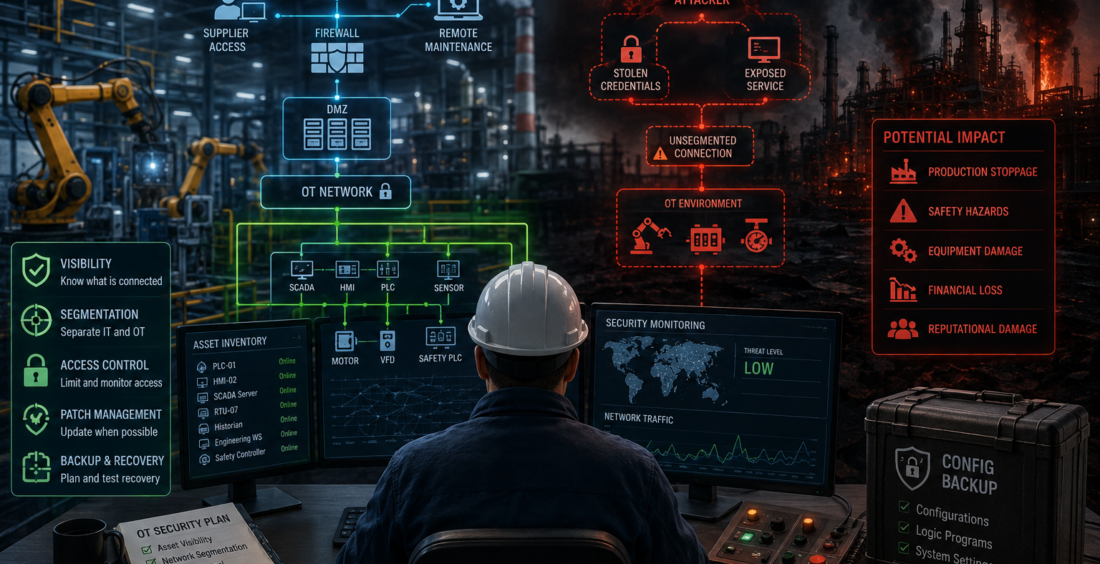
OT cybersecurity is becoming a bigger concern as factories, energy systems, water facilities and other critical services rely on connected technology.
Operational technology, or OT, includes systems that control machines, industrial processes and equipment.
That makes an OT cyberattack different from an ordinary data breach. If an industrial control system is disrupted, production can stop, services can fail and safety may become part of the incident.
Why OT Cybersecurity Feels Different
Most business technology is designed around information. OT is designed around physical processes.
A manufacturing system may control motors, valves or production lines. A water facility may rely on connected equipment to adjust treatment processes. Energy operators use industrial systems to keep infrastructure functioning.
NIST describes OT as programmable systems and devices that interact with the physical environment or manage devices that do.
This means security decisions must consider more than confidentiality. Availability, reliability and safety can be just as important.
Old Equipment Can Be Hard to Replace
Industrial environments often contain equipment that was designed to run for many years.
A laptop might be replaced after several years, while factory equipment may stay in service for decades. Some older equipment was built before modern cybersecurity threats shaped design.
Updating these systems can also be difficult.
A software patch may require testing because failure could interrupt production. Some devices no longer receive vendor updates, while others cannot easily be taken offline.
OT security must balance cyber risk with operational stability.
Connectivity Creates New Paths In
Industrial systems were once easier to separate from normal business networks.
Today, companies want remote maintenance, cloud analytics and easier supplier access. Those connections improve efficiency but also create new routes into sensitive environments.
CISA published secure connectivity principles for operational technology in 2026, emphasizing that organizations should reduce unnecessary exposure and manage connections into OT environments carefully.
Remote access deserves particular attention.
A maintenance connection that is convenient for a trusted supplier can become dangerous if credentials are stolen or access remains open longer than necessary.
Know What Is Actually Connected
One of the hardest security questions in an industrial environment is surprisingly basic: what devices do we have?
Factories and infrastructure operators may have equipment installed by different vendors over many years. Documentation can become outdated, and teams may discover devices only when something fails.
NIST made OT asset management a specific cybersecurity focus in 2026, highlighting the need for visibility into devices, software, communications and dependencies.
An accurate inventory helps teams understand which systems are exposed, which ones need updates and what could be affected during an incident.
You cannot protect equipment nobody knows exists.
Backups Need to Include Operations
Backups are familiar in IT, but OT recovery has its own challenges.
It may not be enough to back up files. Operators may need copies of device configurations, control logic and other information required to rebuild industrial systems safely.
NIST published an Operational Technology Backup Quick Start Guide in June 2026 to help operators develop stronger backup strategies for OT environments.
Those backups also need testing.
A backup that has never been restored is only a promise. During a real incident, teams need confidence that they can bring critical systems back without creating another operational problem.
IT and OT Teams Need to Work Together
Many organizations have separate teams for business technology and industrial operations.
That separation makes sense because the priorities are different. IT teams may focus on data, applications and user accounts. OT teams care deeply about uptime, equipment and physical safety.
Cybersecurity sits between them.
A security control that works perfectly in an office may be inappropriate on a production line. At the same time, operational reliability cannot become a reason to ignore serious cyber risk.
Collaboration matters greatly.
Security teams need to understand operational consequences, while engineers and plant operators need visibility into changing cyber threats.
A Cyber Incident Can Become an Operational Incident
OT cybersecurity matters because the boundary between the digital and physical worlds is getting thinner.
CISA and international partners issued fresh guidance in July 2026 urging critical infrastructure operators to isolate OT and enabling systems where possible to reduce exposure to escalating cyber threats.
The message is practical: connectivity should have a reason, access should have limits and recovery should be planned before something breaks.
Organizations do not need to turn every engineer into a cybersecurity specialist.
They do need to know which systems keep operations running, who can reach them and how quickly they could recover if those systems were disrupted.
The question is not only, “Could an attacker steal our data?”
In an OT environment, the more important question may be, “What could stop working if they get in?”
Contributed by GuestPosts.biz
Further Reading: Cyber Gear Thought Leadership Series







Comments are closed.