
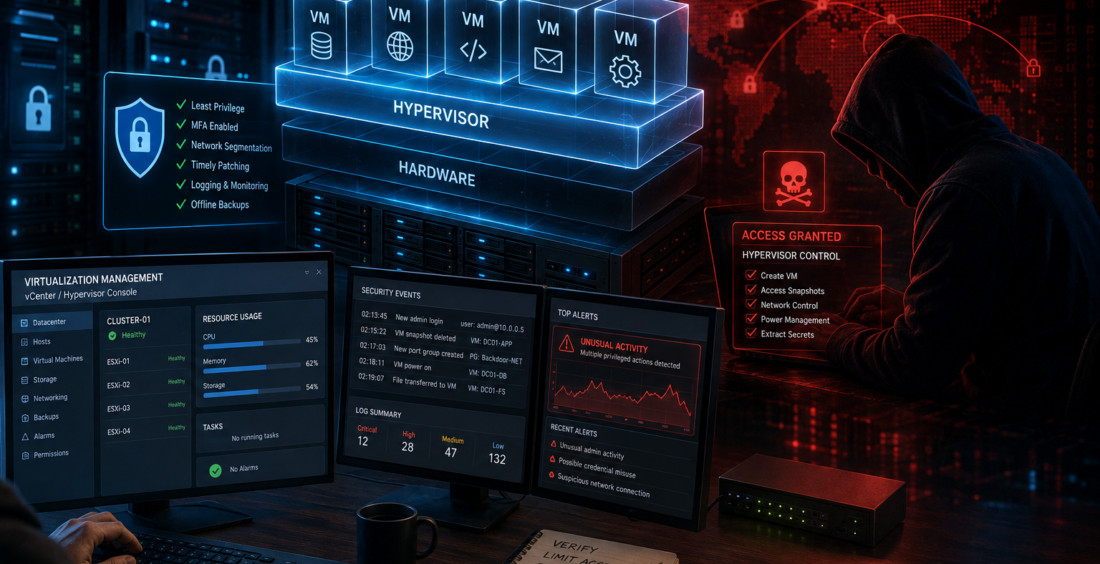
Virtualization security is becoming a bigger cybersecurity concern because a small number of platforms can run a large part of a company’s technology.
A single hypervisor may host dozens of virtual machines. A management console can control servers that support identity, databases, applications and backups.
That concentration is convenient for IT teams. It is also attractive to attackers. If someone gains control of the virtualization layer, they may be able to reach many systems from one place.
Why Virtualization Has Become a Valuable Target
Virtualization platforms sit underneath many business applications.
Instead of managing every server separately, administrators can use platforms such as VMware vSphere or Microsoft Hyper-V to create, move, shut down and manage virtual machines.
That level of control makes the management layer powerful.
Google Threat Intelligence warned in 2026 that threat actors often target virtualization infrastructure during reconnaissance, lateral movement, data theft and ransomware operations.
For an attacker, compromising one management platform can be more efficient than attacking every virtual server individually.
The Hypervisor Can Sit Below Normal Defenses
Most companies protect laptops and servers with endpoint detection and response tools.
The virtualization layer can be different.
Hypervisors and management appliances may not support the same security agents used on ordinary operating systems. That creates a visibility gap.
Mandiant has highlighted this problem while investigating attacks against VMware environments. In its BRICKSTORM guidance, it noted that attackers operating at the virtualization layer can sit beneath guest operating systems where normal endpoint protections may not see them.
That makes logging and monitoring of the management platform especially important.
Administrator Access Deserves Extra Protection
Virtualization administrators often have enormous power.
They may be able to create snapshots, reset virtual machines, change network settings or access systems that contain sensitive information.
Those accounts should not be treated like ordinary user accounts.
Organizations should limit who has administrative access, use separate privileged accounts and require strong authentication wherever possible.
Local administrator credentials also deserve attention. If attackers obtain them, they may bypass controls connected to normal corporate identities.
The question is not just who can sign in. It is what that account can do after it gets there.
Patching the Management Layer Cannot Wait
Virtualization platforms are software, and software develops vulnerabilities.
Patching can be uncomfortable because these systems support important workloads. Teams may worry that an update could interrupt dozens of virtual machines.
But leaving a critical management system exposed can create a larger risk.
Broadcom published multiple VMware security advisories in 2026 covering vulnerabilities in ESX, vCenter and related products.
Organizations should know which versions they run, monitor vendor advisories and have a process for testing and deploying urgent updates quickly.
Backups Are Not Safe Just Because They Are Backups
Virtualization platforms often sit close to backup systems.
That can make them valuable during ransomware attacks. If attackers can delete snapshots, damage backup infrastructure or encrypt virtual machines at scale, recovery becomes harder.
Backups should therefore be separated from the systems they protect where possible.
Administrative credentials for production virtualization should not automatically provide access to backup platforms. Important recovery copies should also be protected from easy deletion.
A backup strategy is strongest when an attacker who controls production still cannot destroy the recovery path.
Watch for Actions That Do Not Fit
Virtualization environments produce important security signals.
A new administrator account, unexpected SSH access, unusual snapshots or sudden changes to virtual networking can all deserve investigation.
In February 2026, Mandiant described an intrusion where attackers created temporary network ports on virtual machines running on an ESXi server and used them to pivot into internal and SaaS environments.
The details may be technical, but the lesson is simple: unusual changes at the virtualization layer can have consequences far beyond that platform.
Virtualization Security Is Business Resilience
Virtualization often disappears into the background when it works well.
Employees see applications, not the infrastructure running them. That can make the underlying platform easy to overlook during security planning.
Attackers do not overlook it.
Companies should treat virtualization management as critical infrastructure. Limit privileged access, patch quickly, collect useful logs, protect backups and make sure recovery procedures are tested.
Security teams should also know who owns the environment and who will respond if the management layer is compromised.
Regular tabletop exercises can expose gaps before a real incident. They help infrastructure, security and recovery teams understand how decisions will be made when a virtualization platform becomes unavailable or untrusted.
The most important question is not simply, “Are our virtual machines protected?”
It is, “What happens if someone gains control of the system that runs all of them?”
That question puts virtualization security where it belongs: at the center of modern cybersecurity resilience.
Contributed by GuestPosts.biz
Further Reading: Cyber Gear Thought Leadership Series







Comments are closed.