
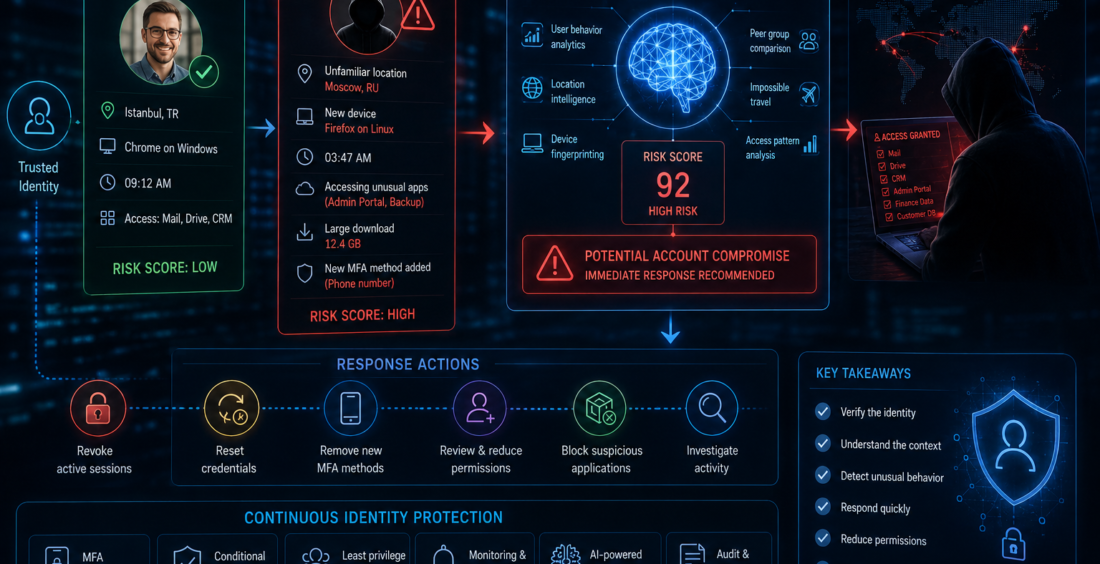
Identity threat detection and response is becoming a cybersecurity priority because attackers try to look like legitimate users.
Instead of dropping malware, they may steal credentials, hijack a session or abuse an account that already has permission to reach systems. Once inside, their activity can blend into normal work.
That creates a question for security teams: how do you spot an attack when the attacker is using an identity?
Why Identity Attacks Are Hard to See
A compromised account does not always behave like malware.
The attacker may sign in to email, open cloud storage or access business applications using credentials that belong to a real employee. If the account has broad permissions, the criminal may not need to exploit another technical weakness.
Microsoft has described identity as a major pressure point in modern cyberattacks and is expanding risk-based identity protection that reacts to suspicious behavior in real time.
The challenge is that successful authentication does not automatically mean the activity is safe.
The Login Is Only the Beginning
For years, organizations have focused heavily on preventing unauthorized logins.
Strong passwords, multi-factor authentication and conditional access remain important. But identity security also needs to continue after the login succeeds.
Imagine an employee normally signs in from Istanbul during business hours and accesses a small group of applications. Suddenly, the same account begins downloading thousands of files, registering a new authentication method and opening unfamiliar cloud services.
Each event might have an innocent explanation.
Together, they tell a different story.
Valid Accounts Can Become Powerful Attack Tools
Attackers value trusted accounts because those identities already have access.
A stolen finance account may reach invoices and payment systems. An administrator account can change security settings. A cloud account may provide access to email, documents and connected applications.
Microsoft documented a 2026 campaign in which Storm-2949 turned compromised identities into broader cloud access and large-scale data theft.
The damage depends less on the stolen password itself and more on what the identity can do once compromised.
Context Makes Detection Stronger
Identity threat detection works best when security teams connect signals instead of looking at each login separately.
Location matters. Device history matters. The applications being accessed matter. So do permission changes, unusual downloads and new authentication methods.
An employee traveling abroad may legitimately sign in from a new location. That alone should not trigger panic.
But a new location combined with a password reset, unusual application access and a large data export deserves attention.
Good detection is about understanding the pattern.
Response Needs to Move Quickly
Finding a compromised identity is only useful if the organization can act.
Security teams may need to reset credentials, revoke active sessions, remove new authentication methods and block suspicious applications. They may also need to review what data the account accessed before the incident was discovered.
Automatically locking every account after one unusual event can disrupt legitimate work. Waiting for perfect certainty can give attackers more time.
Modern identity security needs a balance between fast containment and enough context to avoid unnecessary disruption.
Privileged Accounts Need More Attention
Not every identity creates the same level of risk.
Administrator accounts, finance users, executives and people with access to sensitive data deserve stronger monitoring because compromise can have a larger impact.
Organizations should also review permissions regularly across the business.
Employees change roles. Contractors finish projects. Temporary access becomes permanent because nobody remembers to remove it.
Reducing unnecessary privileges limits what an attacker can reach if an account is stolen.
AI Agents Expand the Identity Problem
Identity security is also moving beyond human users.
AI agents, applications, bots and automated workloads increasingly receive their own credentials and permissions. Microsoft and NIST are both expanding work around protecting human and non-human identities.
These identities can operate much faster than people.
An AI agent may call several tools or services in seconds, which makes real-time monitoring especially important.
Security teams need to know which identities belong to people, which belong to machines and what normal behavior looks like for both.
Identity Security Is Becoming Continuous
The old security model often treated login as the main checkpoint.
That is no longer enough.
A trusted identity can become untrusted during a session. Credentials can be stolen, permissions can be abused and legitimate accounts can start behaving in ways their real owners never intended.
Identity threat detection and response is about watching that change.
The question is not only, “Did the right person sign in?”
It is also, “Does what this identity is doing still make sense?”
As cloud services, AI agents and remote work make identity more central to business, that question is becoming one of the most important in cybersecurity.
Contributed by GuestPosts.biz
Further Reading: Cyber Gear Thought Leadership Series







Comments are closed.