
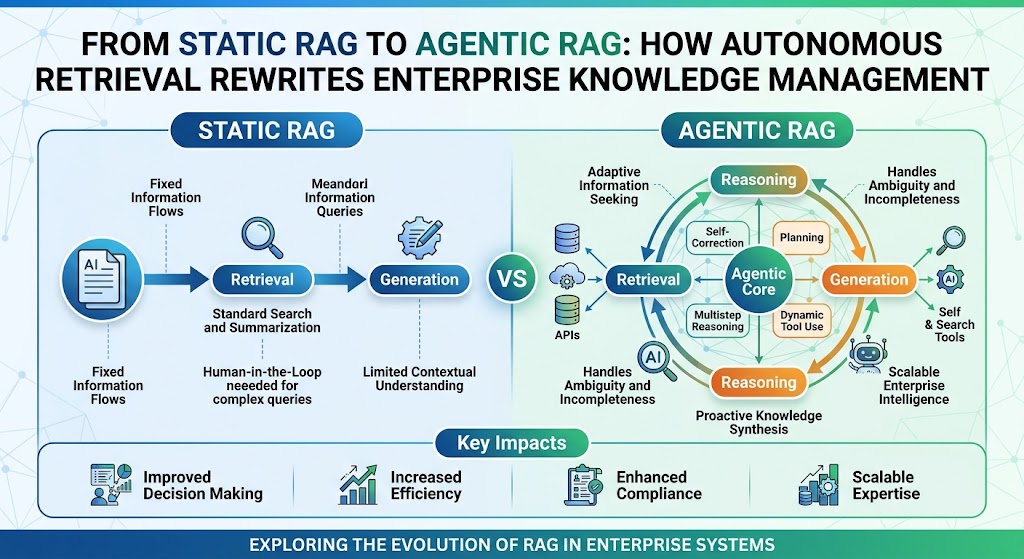
Over the first wave of enterprise language model adoption, Retrieval-Augmented Generation (RAG) became the standard pattern for grounding large language models in private data. Corporations attached vector databases to chat-style interfaces, enabling employees to ask questions over internal policy documents, product manuals, and customer service transcripts. Static RAG provided marginal improvements in contextual accuracy over vanilla language models, but proved to have significant shortcomings when it came to knowledge management
Static RAG architectures suffered from the one-shot retrieval paradigm
where a single prompt gets encoded as vectors, matched to the most relevant document chunks, and fed directly into the model context. If the retrieved document chunks contained insufficient or even contradicting information, the entire RAG inference was compromised. Users were left to do extra work to rephrase prompts or perform multi-step reasoning to get at the information they needed.
Modern applications are adopting an agent-centric approach to information retrieval, known as Agentic RAG.
Agentic RAG Architecture Overview
Whereas traditional retrieval methods are passive and wait for user input, agentic RAG pipelines contain at least one autonomous agent that performs active reasoning to satisfy a user request. The agentic retrieval paradigm transforms the database lookup step from a rigid procedure into an iterative process
An agentic retrieval pipeline contains these elements:
• Query decomposition: the user request is analyzed and broken down into sub-queries that target different data sources.
• Multi-source routing: individual sub-queries are sent to the most relevant database, which might include a graph database or a relational SQL database.
• Self-reflective re-retrieval: if certain document chunks contained conflicting or ambiguous information, the agent would identify this and perform further searches instead of presenting the information to the user.
• Synthesized validation: the retrieved information is synthesized in light of other relevant rules before being presented to the user.
The Business Value of Agentic RAG Systems
The performance gains of agentic RAG are especially valuable for knowledge-intensive industries that perform research across disparate database sources. For instance, within a regulatory compliance use case, traditional RAG workflows would require auditors to perform multi-day searches over policy databases, contract repositories, and email archives before finding relevant information. Meanwhile, an agentic RAG would ingest the audit request, deconstruct it into its constituent parts, and query the various databases to find documents that explicitly mention the relevant regulations. Enterprises that want to begin harnessing the power of agentic information retrieval can partner with a specialized AI agent development company to build custom RAG pipelines.
Considerations for Agentic RAG Pipelines
When implemented correctly, agentic RAG pipelines provide exponential gains in information retrieval. However, enterprises must remain mindful of the following considerations when implementing agentic systems:
• Context saturation: recursive retrieval can cause a single prompt to exceed context length limits, especially when the agent performs multiple iterations of re-retrieval.
• Dynamic access control: agentic systems should not retrieve information that the end-user is not permitted to see. A robust agentic RAG will have access control features such as role-based access to certain data sources and proxies that sanitize data before presenting it to the user.
• Enterprise readiness: agentic RAG systems require mature infrastructure to handle recursive retrieval and prevent unauthorized disclosure of information. Organizations can begin working with established providers in the enterprise AI Agent space to deploy agentic RAG applications.
Contributed by GuestPosts.biz
Further Reading: Cyber Gear Thought Leadership Series







No comments yet.