
For the majority of the last decade, enterprise artificial intelligence has been heavily centralized in cloud computing infrastructure. Models have been hosted in data centers, and devices across the network edge have acted as data sources and operated as data collection nodes, transmitting telemetry over the internet for processing.
While cloud-centric processing is effective for non-tactical applications, it introduces unacceptable levels of operational friction for enterprises managing real-time functions. The reliance on cloud connections introduces network latency, massive bandwidth expenditure, exposure of telemetry data, and system operations susceptible to intermittent connectivity failures. In high-impact physical environments such as automated manufacturing plants, offshore oil rigs, and logistics hubs, waiting for a cloud server to process a query and return a result takes too long.
These factors are driving the enterprise push towards Edge AI Agents.
The Architecture of On-Device Agentic Intelligence
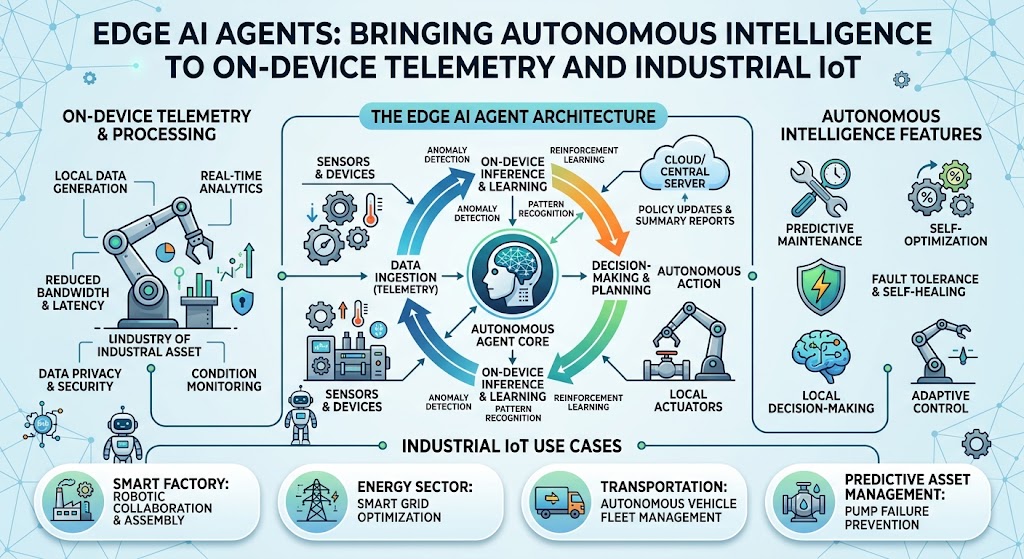
Edge AI Agents represent an architectural paradigm shift. Rather than relying on a centralized processing engine, lightweight AI models are deployed directly onto edge hardware processors, microcontrollers, and servers.
Operating autonomously, these agents can execute localized decision loops including:
• Real-Time Anomaly Detection: agents can process high-frequency streams of sensor data (vibration telemetry, thermal imaging, sound) to detect early signs of operational deviations
• Local Event Execution: when an anomalous event occurs (e.g. overheating robotic arm), the edge agent can initiate on-the-spot system interventions
• Bandwidth Optimization: to reduce network overhead, the edge agent performs in situ data aggregation and only reports relevant high-level operational summaries to enterprise systems
• Offline Resilience: if network connectivity is lost, the edge agent can continue operating independently
The Practical Value of Edge AI Agents
The value of Edge AI Agents is being realized in a variety of industrial and field settings. Let’s consider a predictive machinery maintenance application running on a modern automated manufacturing plant. Within a traditional cloud-connected monitoring system, vibration data from thousands of motor sensors would be processed across local networks into central repositories.
With Edge AI Agents, individualized sets of localized sensors run lightweight neural networks directly on the hardware node. The edge agent is able to learn the normal operating pattern of the machine and recognize when unusual microscopic friction patterns emerge as an indicator of impending machinery failure. The agent can then automatically slow down the movement of the affected machinery, order a replacement part from enterprise inventory systems, and alert a technician to arrive onsite. Enterprises looking to develop localized domain expertise can work with custom AI agent developers to create intelligent industrial environments.
Security, Privacy, and Hardware Constraints
The deployment of autonomous agents onto distributed edge hardware does introduce unique engineering and governance challenges. Edge devices typically have limited compute, memory, and power budgets, necessitating the use of model quantization, network pruning, and specialized accelerators (NPUs) to run agentic loops. From a security perspective, edge agents provide improved data privacy by keeping sensitive operational telemetry and video feeds within local network perimeters. However, physical edge hardware requires enhanced security to prevent tampering and unauthorized firmware modifications. Secure boot processes and enterprise AI Agent architecture firmware updates help to secure the edge network.
As edge computing hardware continues to evolve, intelligence will continue to move closer to the point of action. Organizations which embrace cloud orchestration combined with localized edge execution will see significant improvements to system responsiveness and overall reliability.
Contributed by GuestPosts.biz
Further Reading: Cyber Gear Thought Leadership Series







No comments yet.