
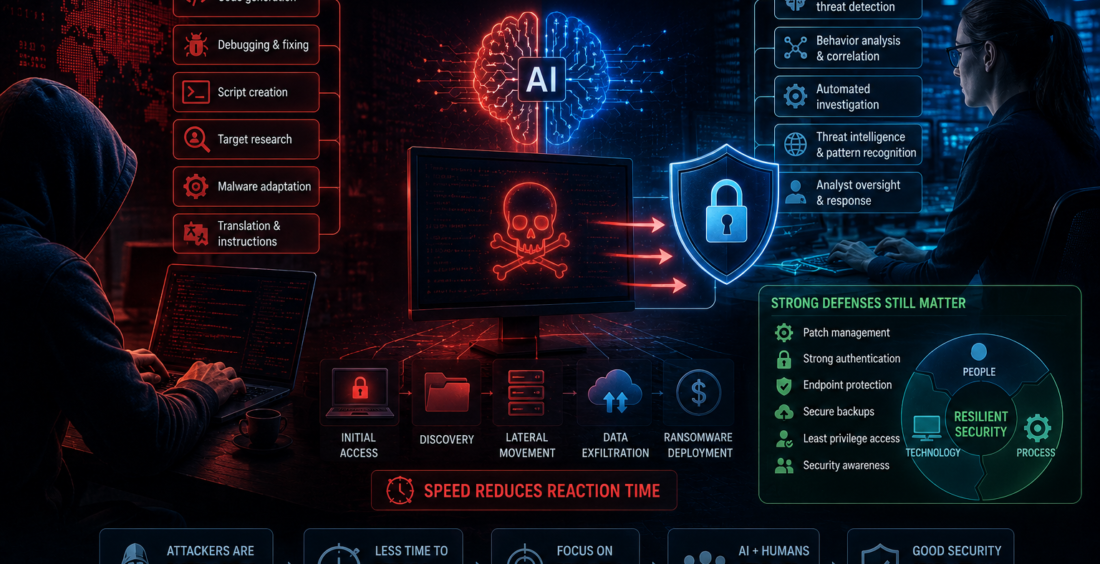
AI-powered malware is changing the cybersecurity conversation because attackers can use artificial intelligence to speed up tasks that once required more time and skill.
That does not mean autonomous malware is everywhere. Most attacks still involve people making decisions. What is changing is the pace. AI can help criminals write scripts, debug malicious code, research targets and adjust tools more quickly.
For defenders, the concern is less about science-fiction malware and more about attackers becoming faster and more productive.
How AI Is Changing Malware Development
Malware development has traditionally required technical knowledge, testing and repeated troubleshooting.
AI can shorten parts of that process.
An attacker may use a language model to explain an error, rewrite a script, create code for a particular operating system or translate technical instructions. Microsoft says threat actors are using generative AI to generate and debug malware, build scripts and support other parts of the attack lifecycle.
The technology does not remove the need for criminal expertise, but it can lower the effort required to experiment.
That matters when attackers can try more ideas in less time.
Faster Attacks Can Be Harder to Follow
Speed creates its own cybersecurity problem.
An attacker who gains access to a system may need to understand the environment, find valuable data and choose a way to move deeper into the network. AI can help organize stolen information, summarize technical details and suggest possible next steps.
Google Threat Intelligence has observed threat actors using AI to accelerate reconnaissance, social engineering and malware development.
This means defenders may have less time between the first sign of suspicious activity and the moment an incident becomes serious.
Security teams cannot assume an attacker will move slowly enough to be noticed manually.
Adaptive Malware Needs Some Perspective
The phrase “AI-powered malware” can easily become exaggerated.
There is an important difference between malware that contains an AI model and criminals who use AI while creating or operating malware. Today, much of the real-world activity falls into the second category.
Microsoft has noted that humans are still typically involved in AI-assisted attacks rather than fully autonomous systems running entire campaigns.
That distinction matters.
Companies should prepare for faster and more flexible attacks without assuming every piece of malware has suddenly become intelligent.
Detection Has to Focus on Behavior
Traditional security tools often look for known malicious files, code patterns or indicators connected to earlier attacks.
Those methods are still useful.
But if attackers can modify scripts and produce new variations more quickly, defenders also need to focus on behavior.
A program suddenly accessing large numbers of files, creating unusual processes, contacting unfamiliar servers or trying to disable security tools should attract attention even if the file itself has never been seen before.
Behavior tells a story that a filename or signature may miss.
Good visibility across endpoints, identities and cloud services helps security teams connect those clues.
AI Helps Defenders Too
Artificial intelligence is not only making attackers more efficient.
Cybersecurity teams are using AI to summarize alerts, investigate suspicious activity and identify patterns across security data. These tools can help analysts spend less time sorting through routine information.
The important difference is how much authority the AI receives.
A defensive tool that recommends isolating a laptop carries less risk than one that can automatically shut down important systems.
As with any automation, speed should be balanced with safeguards and human judgment.
Basic Security Still Matters
AI can make attacks faster, but it does not make basic security irrelevant.
Many incidents still begin with familiar weaknesses: an unpatched system, a stolen account, an unsafe download or an employee tricked by social engineering.
Strong authentication, timely patching, endpoint protection, secure backups and limited administrator access continue to make an attacker’s job harder.
The technology behind an attack may change while the doorway remains familiar.
Businesses should avoid chasing every AI headline and forgetting the controls that stop real intrusions today.
The Real Change Is the Tempo
AI-powered malware is best understood as part of a wider change in cybercrime.
Attackers have new tools that can help them research, write, test and adapt faster. That does not guarantee success, but it can increase the number of attacks they attempt and reduce the time defenders have to react.
Organizations need security operations that can keep pace.
That means better visibility, faster investigation, sensible automation and people who understand when a machine-generated alert needs human attention.
The question is not whether AI will create an unstoppable form of malware.
A better question is whether an organization can recognize and contain an attack when the person behind it is working much faster than before.
That is the cybersecurity challenge AI is already making real.
Contributed by GuestPosts.biz
Further Reading: Cyber Gear Thought Leadership Series







Comments are closed.