
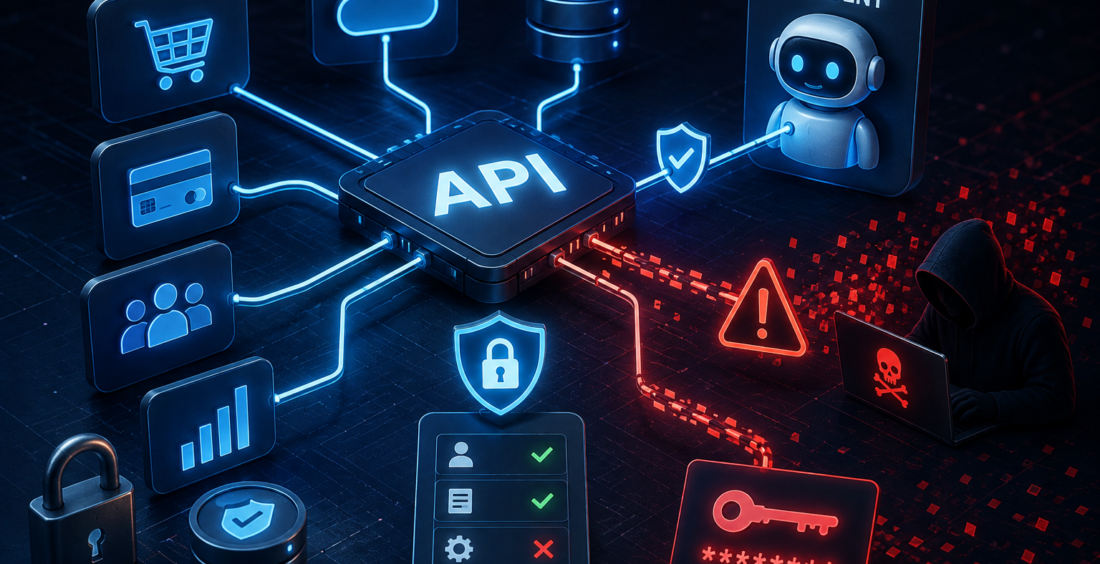
API security is becoming a major cybersecurity concern as businesses connect applications, cloud services and AI systems. APIs allow software to exchange information and take actions without a person clicking through every step.
That makes services faster and more useful. It also means one poorly protected connection can expose data or give an attacker access to functions they should never reach.
As AI agents gain the ability to call APIs, those connections deserve more attention. That matters because one compromised API can expose several connected systems.
Why APIs Matter So Much Now
An API is essentially a doorway between systems.
A shopping app may use one API to process payments and another to check delivery information. A business platform might connect customer records, email, analytics and cloud storage.
AI agents make those connections even more important because they can use APIs to turn a request into an action.
An agent might retrieve a document, update a customer record or send a message. If the API behind that action has weak security, the problem can move beyond the AI itself.
Authentication Is Only the Beginning
Many organizations focus on making sure an API knows who is calling it. That is important, but authentication alone is not enough.
A legitimate user or application should still be limited to the information and actions it actually needs.
OWASP lists broken authorization among the leading API security risks. In simple terms, an API may recognize a user but still allow that user to access records or functions that belong to someone else.
The system knows who you are. It still needs to check what you are allowed to do.
API Keys Can Become Digital Master Keys
API keys and tokens are often used to let applications communicate automatically.
Problems begin when those credentials are treated casually. A developer may place a key in public code, copy it into an insecure file or leave an old credential active after a project ends.
If an attacker finds that key, they may be able to use the same permissions as the application.
Keys should be stored securely, rotated when needed and removed when they are no longer required. Powerful credentials should also be limited.
Convenience should not turn one secret into access to everything.
AI Agents Raise the Stakes
Traditional software usually follows a predictable path. An AI agent can be more flexible.
It may choose which tool to use, decide which API to call and chain several actions together to complete a task. That is useful, but it also means a bad instruction can travel further.
Imagine an agent asked to review a customer request. Malicious content inside that request tries to persuade the agent to retrieve confidential data and send it somewhere else.
If the agent has broad API permissions, a misleading instruction could become a real action.
This is why agent permissions and API security need to be designed together.
Rate Limits Are About Security Too
APIs can process requests far faster than a person can click a button.
Attackers can exploit that speed by making many requests, testing identifiers or collecting information automatically.
Rate limits help prevent one account or application from making unlimited requests in a short period.
They can make automated abuse harder and give security teams more time to notice unusual behavior.
A sudden spike in API activity can also be an important warning sign.
Know Which APIs You Actually Have
One of the hardest API security problems is surprisingly basic: organizations do not always know every API they operate.
Old services remain online. Development interfaces become permanent. Teams create internal APIs for short projects and forget about them.
These forgotten connections can become attractive targets because they may receive fewer updates and less monitoring.
Companies should maintain an inventory of important APIs, understand what data they expose and know who owns them.
NIST recommends structured controls for protecting APIs in cloud-native environments, including strong authentication and authorization.
Visibility comes before protection.
Good API Security Is About Boundaries
APIs are becoming more central as cloud platforms, automation and AI connect more parts of a business.
The goal is not to make every connection difficult. It is to make sure each connection has clear boundaries.
Know which APIs exist. Protect credentials. Limit permissions. Monitor unusual activity. Remove old access and require extra checks for sensitive actions.
As AI systems become more capable, an API can be the point where an automated decision becomes a real business action.
That makes one question important:
What can this API do if the wrong person, application or AI agent gains access to it?
The answer tells you how seriously that connection should be protected.
Contributed by GuestPosts.biz
Further Reading: Cyber Gear Thought Leadership Series







Comments are closed.