
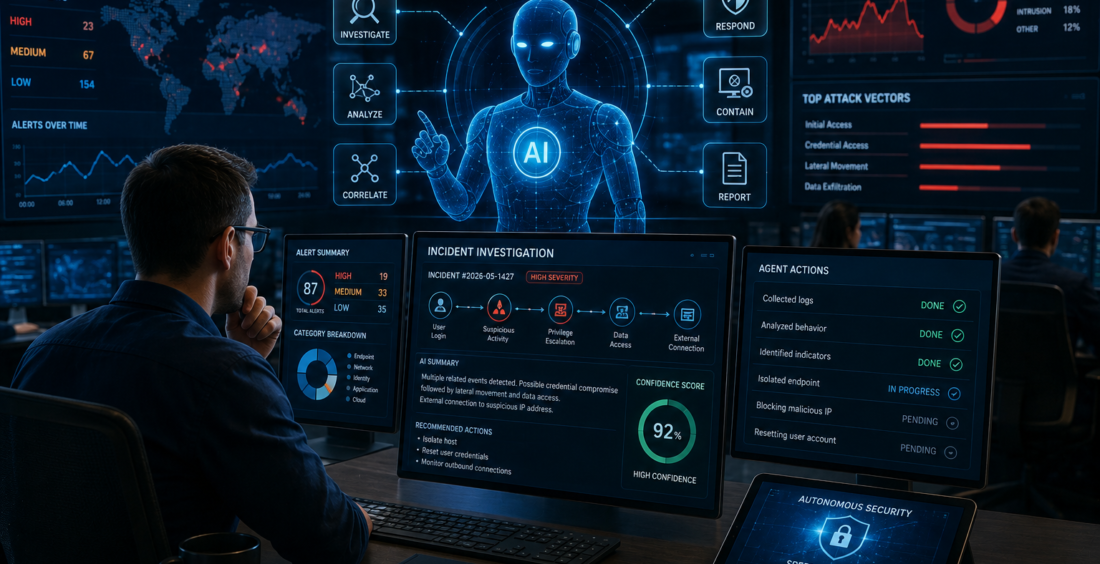
Autonomous cybersecurity is becoming a practical part of security operations. AI systems can investigate alerts, connect clues, summarize incidents and sometimes take defensive action.
That can help teams facing thousands of alerts. But giving AI more freedom raises a question: how much should a machine do without a person approving every step?
The answer will shape how companies use AI inside the security operations center, or SOC.
Why Security Teams Are Turning to AI
Cybersecurity teams have a simple problem: there is often more activity than people can review.
An analyst may check login records, endpoint alerts, email activity and cloud events before deciding whether something is dangerous. Many alerts are harmless, but each still takes time.
AI can connect that information quickly. Instead of twenty separate warnings, it can group related events, explain what happened and suggest what to investigate next.
That does not replace judgment. It gives people a faster starting point.
From Assistant to Security Agent
The bigger shift comes when AI moves beyond advice.
An AI agent may be able to investigate suspicious activity, gather evidence and trigger a response. It could disable a compromised account, isolate a laptop or block a malicious connection.
Microsoft is expanding agentic capabilities in its security products, including autonomous agents that help teams investigate and respond to threats.
A useful security agent needs enough access to act. Too much access, however, can create a new source of danger.
Speed Is Useful Until Something Goes Wrong
One reason organizations want autonomous security is speed.
Attackers do not wait for office hours. If suspicious activity begins at 3 a.m., an AI agent might react before an analyst is available.
That can reduce the time an attacker has to move through a network.
But automation can also amplify mistakes. If an agent misunderstands normal behavior as an attack, it could lock an important account or disconnect a system that employees need.
For that reason, companies should decide which actions can happen automatically and which ones still need human approval.
Blocking a known malicious domain may be low risk. Shutting down a production server is not.
Why Autonomous Cybersecurity Needs Human Oversight
An autonomous SOC can sound like security without people. That is unlikely to be the best model.
Humans are good at context.
An analyst may know that unusual network activity is connected to a planned software migration or that a senior employee is traveling. AI may see unusual behavior without understanding the business reason behind it.
People also make decisions when the consequences are unclear.
The strongest approach is likely to combine machine speed with human judgment. AI can collect evidence, prioritize alerts and handle repetitive work while analysts focus on decisions where context matters.
Security Agents Need Security Too
There is an important irony in using AI agents for cyber defense: the agents themselves become systems that need protection.
A security agent may have access to sensitive logs, user accounts and powerful administrative tools. If an attacker manipulates the agent or gains control of its credentials, that access could be abused.
NIST is working on standards for secure and interoperable AI agents, while Microsoft has emphasized defense-in-depth controls for autonomous agents.
Organizations should give security agents clear identities, limited permissions and detailed activity logs. They should also test how agents behave when they receive misleading or conflicting information.
An AI defender should not become an attacker’s shortcut.
Trust Has to Be Earned
Companies do not need to choose between fully manual security and complete automation.
Autonomy can grow gradually.
A new AI system might begin by summarizing alerts. Later, it could recommend actions. Once the organization understands how reliably it behaves, selected low-risk responses could happen automatically.
This approach gives security teams time to build confidence without handing over too much control at once.
It also creates a clear record of what works, what fails and where human review is still valuable.
The SOC Is Becoming a Team of Humans and Machines
AI will probably not remove people from cybersecurity operations. It will change what they spend their time doing.
The repetitive parts of investigation are good candidates for automation. The difficult decisions involving business impact, uncertainty and accountability still need people.
That balance matters.
The goal is not to build a SOC where AI makes every decision. It is to build one where people and machines each handle the work they are best suited to do.
As autonomous cybersecurity becomes more capable, the most important question will not be whether AI can respond to an attack.
It will be whether organizations can trust it to take the right action, with the right level of authority, when the pressure is real.
Contributed by GuestPosts.biz
Further Reading: Cyber Gear Thought Leadership Series







Comments are closed.