
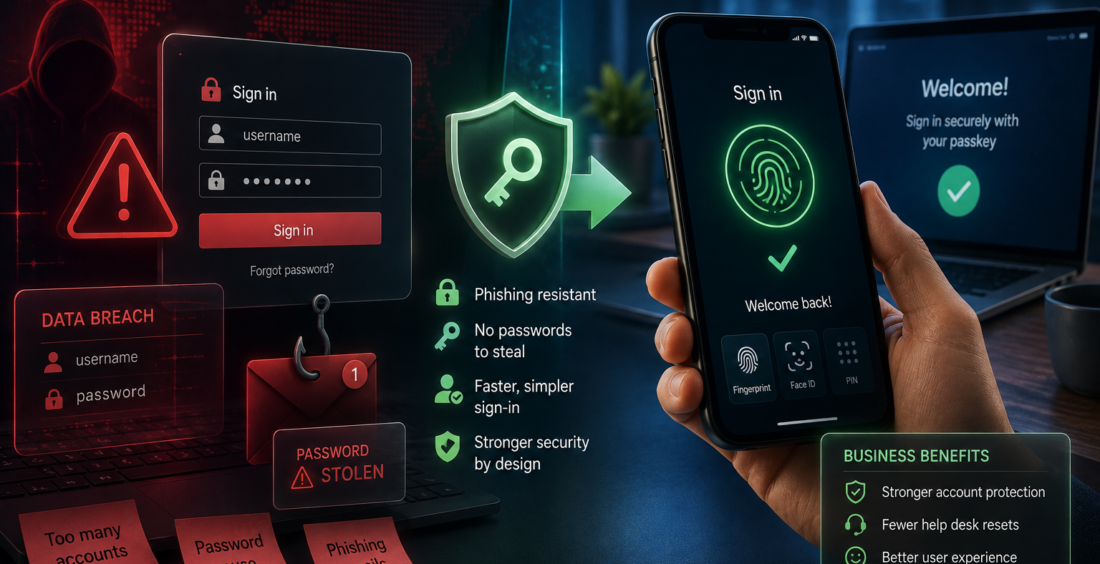
Passkeys are moving from a promising security idea to something people are using. Instead of typing a password, users can sign in with a device they already trust, often using a fingerprint, face scan or PIN.
That matters because passwords remain a common cybersecurity target. They can be guessed, reused, stolen in data breaches or handed over on convincing phishing pages.
Passkeys change the equation by removing the reusable secret that criminals usually want to steal.
Why Passwords Keep Creating Problems
Passwords were never designed for the number of accounts people manage today.
Employees are expected to remember credentials for email, cloud services, financial systems and customer platforms. That burden encourages password reuse and unsafe storage.
A single stolen password can be tested against several services. Phishing emails can send users to fake login pages, while malware can collect credentials from devices.
Multi-factor authentication improved the situation, but some forms of MFA can still be defeated through social engineering or phishing.
How Passkeys Change the Login
A passkey works differently from a password.
Instead of sharing a secret with a website, a cryptographic credential is linked to the real service. The private part stays protected on the user’s device or credential provider, while the website verifies the login.
The FIDO Alliance describes passkeys as phishing-resistant because they are tied to the legitimate website. A fake login page cannot simply collect the passkey and reuse it somewhere else.
For the user, the experience can feel much simpler. They may confirm the login with the same fingerprint, face recognition or device PIN they already use every day.
Why Phishing Resistance Matters Now
Phishing has become harder to spot.
AI can help attackers write cleaner emails, imitate business language and create convincing messages quickly. Criminals also use adversary-in-the-middle techniques that can capture passwords, one-time codes and active sessions.
This makes authentication methods that depend less on users recognizing a fake page increasingly valuable.
CISA recommends moving toward phishing-resistant MFA based on FIDO standards where possible. Microsoft has also been expanding passkey support across consumer and enterprise accounts.
The goal is not simply to make passwords stronger. It is to reduce how often passwords are needed at all.
Passkeys Do Not Fix Every Identity Problem
Passkeys are a major improvement, but they are not magic.
An attacker may still target account recovery, help desk processes or a device that is already compromised. If a company allows users to fall back to a weak password or an easily abused recovery method, the stronger login can be undermined.
Microsoft has warned that passkeys are not the finish line if weaker fallback and recovery options remain available.
That means organizations need to look at the full identity journey, including enrollment and recovery.
A strong front door does not help much if the side door is left open.
Rollout Needs to Be Practical
Moving away from passwords takes planning.
Some older applications may not support modern authentication. Employees may use several devices. Contractors and temporary staff may have different access needs. Support teams also need a clear process when someone loses a device.
Organizations do not have to migrate everyone on the same day.
A sensible starting point is accounts with the most valuable access, such as administrators, finance teams, executives and employees who handle sensitive data.
From there, passkeys can expand as systems and users are ready.
The User Experience Is Part of Security
Security tools work best when people actually want to use them.
One reason passkeys are gaining attention is that they can make login easier as well as safer. Users do not need to invent another complex password, remember it or type it into a small mobile screen.
According to the FIDO Alliance’s 2026 State of Passkeys report, passkey adoption has moved into the mainstream, with billions of passkeys active globally and growing workforce deployment.
That matters because better security often fails when it creates too much friction.
The Passwordless Shift Is Really About Trust
Passwords are unlikely to disappear overnight. Many systems will continue using them for years.
But the direction is changing.
Passkeys give businesses a practical way to reduce phishing risk while making authentication easier for users. The bigger lesson is that cybersecurity should not depend on people perfectly recognizing every fake website, message or login request.
Technology should remove opportunities for attackers where possible.
Organizations should start by identifying which systems support passkeys, protecting high-risk accounts first and reviewing recovery methods that could weaken the new controls.
The question is no longer whether people can create stronger passwords.
It is whether businesses can finally design authentication that does not need passwords to carry so much of the security burden.
Contributed by GuestPosts.biz
Further Reading: Cyber Gear Thought Leadership Series







Comments are closed.