
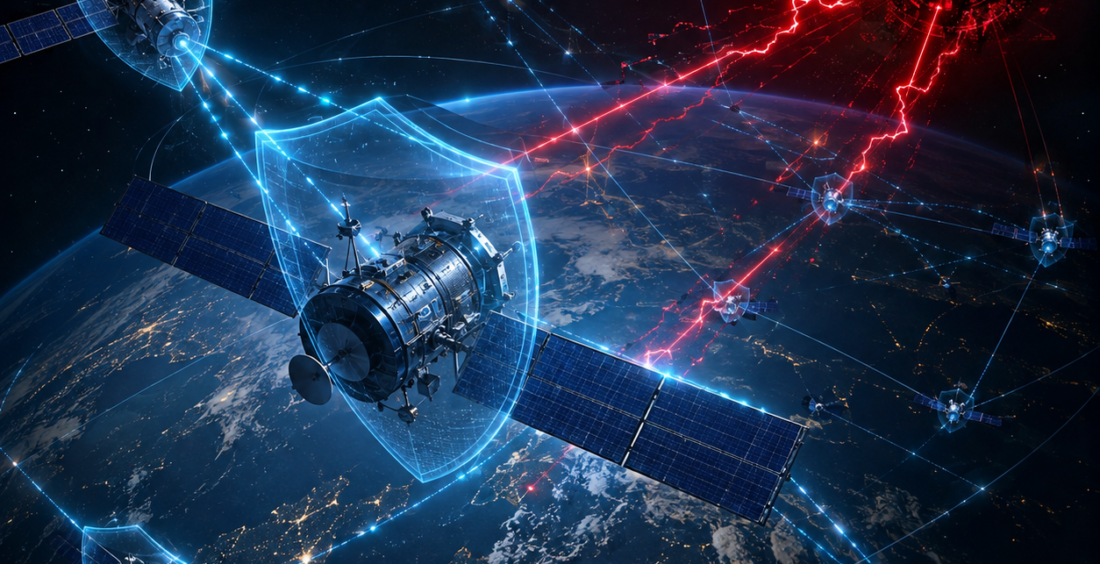
Satellite cybersecurity is becoming more important as businesses, governments and emergency services rely on space-based communications for everyday operations.
Low Earth Orbit satellite networks can provide internet access, navigation support and connectivity in places where terrestrial networks are unavailable.
That dependence creates a new cybersecurity question: what happens when the communication system is hundreds of kilometers above the ground but the attack begins through software, credentials or a ground station?
A Satellite System Is More Than the Satellite
When people think about satellite security, they often picture the spacecraft itself.
The real system is much larger.
It includes ground stations, control centers, user terminals, communication links, software platforms and the supply chain behind them.
NSA and Australian partners issued joint guidance in 2026 covering cybersecurity risks across Low Earth Orbit satellite communication systems.
An attacker may not need to reach the satellite directly if a weaker ground-based component provides another path.
Ground Systems Can Be the Easier Target
Satellites are difficult and expensive to access physically.
Ground infrastructure looks more familiar to cybercriminals.
Control systems may use ordinary servers, cloud services, administrator accounts and network connections. If those systems are poorly protected, attackers can use techniques that already work against terrestrial organizations.
Stolen credentials, vulnerable software and misconfigured remote access can all matter.
NIST’s satellite cybersecurity guidance emphasizes protecting ground systems used for satellite command and control.
Space cybersecurity therefore includes many of the same fundamentals as enterprise cybersecurity.
User Terminals Need Attention Too
Satellite services often depend on terminals installed at customer locations.
These devices may sit on rooftops, ships, remote sites or temporary facilities.
They can become part of the attack surface if default credentials remain active, software is outdated or management interfaces are exposed.
Organizations using satellite communications should know who manages those terminals, how they receive updates and what happens when a vulnerability is discovered.
A secure satellite does not help much if the equipment connecting the user to it is poorly protected.
Jamming and Spoofing Add a Different Kind of Risk
Satellite communications face threats that ordinary business networks may encounter less often.
Jamming attempts to interfere with a signal so legitimate communication becomes unreliable or unavailable.
Spoofing tries to make a receiver trust a false signal or source.
These attacks can affect availability and confidence in the information being received.
The 2026 joint guidance on LEO satellite communications highlights risks across communication links as well as the ground, space and user segments.
Resilience therefore needs to consider both traditional cyber compromise and interference with the signal itself.
Supply Chains Reach Into Space
Satellite systems depend on hardware, software and services from many suppliers.
A vulnerability introduced by a contractor, component manufacturer or software provider can become part of the final system.
That makes supply-chain security especially important because replacing technology after launch can be difficult or impossible.
Organizations should understand which vendors support critical components, how software updates are verified and how security issues are disclosed.
The same software bill of materials thinking used in enterprise technology can help identify dependencies that might otherwise remain hidden.
Updates Are Harder When Hardware Is in Orbit
A laptop can be replaced when it reaches the end of support.
A satellite cannot be brought back to the office for a hardware upgrade.
That changes the importance of secure design.
Space systems need strong update mechanisms, carefully protected command channels and enough flexibility to respond to vulnerabilities discovered years after launch.
The IEEE published a space system cybersecurity design standard in 2026 addressing security across ground systems, space vehicles and communication links.
Design decisions made before launch can shape cybersecurity for the entire mission.
Resilience Matters as Much as Prevention
Satellite operators and customers need plans for disruption.
That might include alternative communications, redundant systems, secure recovery procedures and clear responsibilities between the provider and the customer.
If a remote operation suddenly loses communications, teams need to understand which business or safety processes are affected and what backup options exist.
Space Cybersecurity Is Becoming Everyday Cybersecurity
Satellite communications are no longer limited to specialized government programs.
Commercial networks are becoming part of ordinary connectivity, logistics, emergency response and critical infrastructure.
That means organizations using satellite services need to ask practical security questions before they become dependent on them.
Who manages the terminals? How are credentials protected? What does the provider monitor? How are vulnerabilities handled? What happens if the service is disrupted?
The key question is not simply, “Is the satellite secure?”
It is, “Is the entire chain between our users and that satellite resilient enough to keep working when something goes wrong?”
As space becomes part of normal business infrastructure, that question belongs firmly inside the cybersecurity conversation.
Contributed by GuestPosts.biz
Further Reading: Cyber Gear Thought Leadership Series







Comments are closed.