
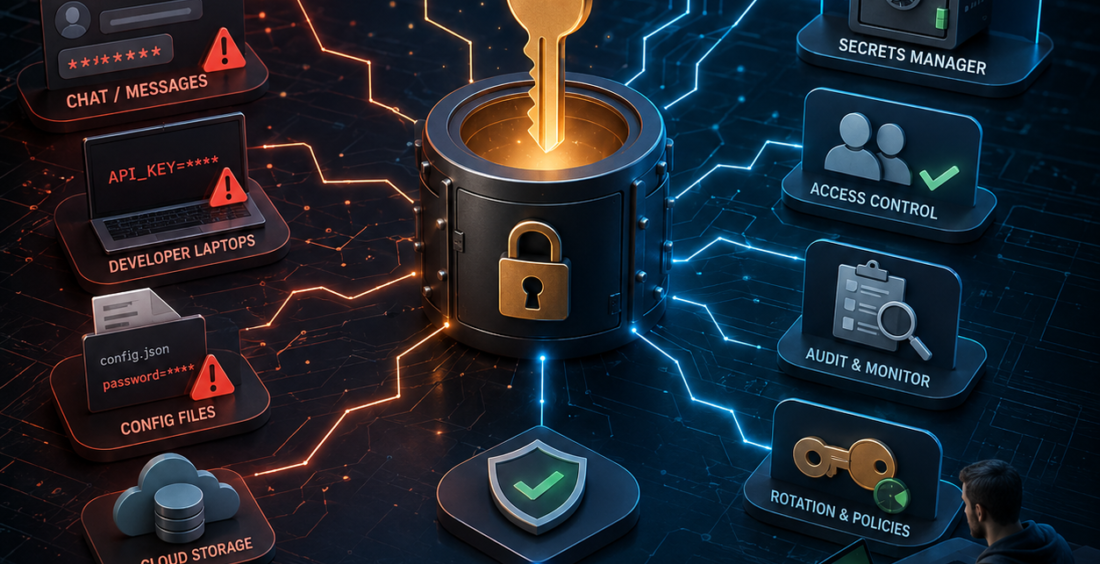
Secrets sprawl is becoming a serious cybersecurity problem as companies rely on more cloud services, APIs, automation and AI tools.
In this context, a “secret” is not a confidential document. It is a password, API key, access token, database credential or other information that lets software prove its identity.
The problem starts when these credentials are copied into source code, chat messages, configuration files, developer laptops and automated pipelines until nobody is quite sure where they live.
Why Secrets Spread So Easily
Modern software needs systems to talk to each other.
An application may need a key to reach a payment service. A script may need a token to access cloud storage. An AI agent may need credentials to call an API or retrieve business data.
Developers often create these connections quickly because they are trying to get something working.
A credential gets pasted into a test file “just for now.” Someone shares a token with a colleague in chat. A temporary key becomes permanent because the project moves on.
That is how secrets sprawl begins.
A Leaked Secret Can Act Like a Real User
The danger is that many secrets do not merely reveal information. They provide access.
OWASP notes that secrets such as API keys and database credentials are commonly used for machine-to-machine authentication. If one is exposed, an attacker may be able to authenticate as the legitimate application.
That can make a stolen token more useful than a stolen document.
The attacker may be able to read cloud data, call an API, access a database or interact with development systems without knowing an employee’s password.
Source Code Is an Easy Place to Make a Mistake
Developers work quickly, and credentials sometimes end up inside code.
A key may be added while troubleshooting and accidentally committed to a repository.
GitHub uses secret scanning to detect exposed tokens, API keys and other credentials, including patterns that appear in code repositories.
The safest approach is to avoid putting secrets into source code. Applications should retrieve them securely when needed rather than carrying them inside the codebase.
AI Can Increase the Amount of Copying
AI coding assistants and agents add another place where secrets can accidentally travel.
A developer debugging an application might paste a configuration file into an AI prompt without noticing that it contains a token. An autonomous coding agent may also have access to environment variables or development credentials while running tools.
That does not make AI uniquely unsafe. It means companies need to understand what information their AI tools can see.
Rotation Matters When Exposure Happens
Finding a leaked credential is only the first step.
If a secret has been exposed, teams should assume someone else may have copied it. Removing it from a repository or deleting the message does not make the old credential safe again.
GitHub recommends rotating exposed API keys and personal access tokens when sensitive data leaks occur.
Rotation means replacing the old secret with a new one and making sure the old credential no longer works.
The faster that happens, the smaller the window an attacker has to reuse it.
Centralize Secrets Instead of Hiding Them Everywhere
A secrets manager gives organizations a controlled place to store and distribute credentials.
OWASP recommends centralized secrets management so companies can better control storage, access, auditing and rotation.
Instead of a password sitting inside a spreadsheet or configuration file, an application can request the credential when it needs it. Access can be logged, limited and revoked.
Centralization does not remove every risk, but it makes secrets easier to manage than dozens of copies spread across the business.
Short-Lived Credentials Reduce the Damage
Not every credential needs to remain valid for months or years.
Where possible, organizations can use short-lived tokens that expire automatically. If one is stolen, the attacker has less time to use it.
Permissions should also be narrow.
A reporting application that only needs to read data should not receive a token that can delete records or change account settings.
This is the same least-privilege principle used across cybersecurity: give an identity only the access it needs.
Secrets Should Have a Lifecycle
The biggest mistake is treating a credential as something created once and forgotten.
Secrets should have owners, expiration rules and a process for rotation and removal. Teams should know where credentials are used and what would happen if one leaked.
The question is not, “Do we have passwords and API keys?”
The better question is, “Do we know where our secrets are, who can use them and how quickly we can replace them?”
When that answer is unclear, a small string of characters can become a surprisingly large cybersecurity risk.
Contributed by GuestPosts.biz
Further Reading: Cyber Gear Thought Leadership Series







Comments are closed.