
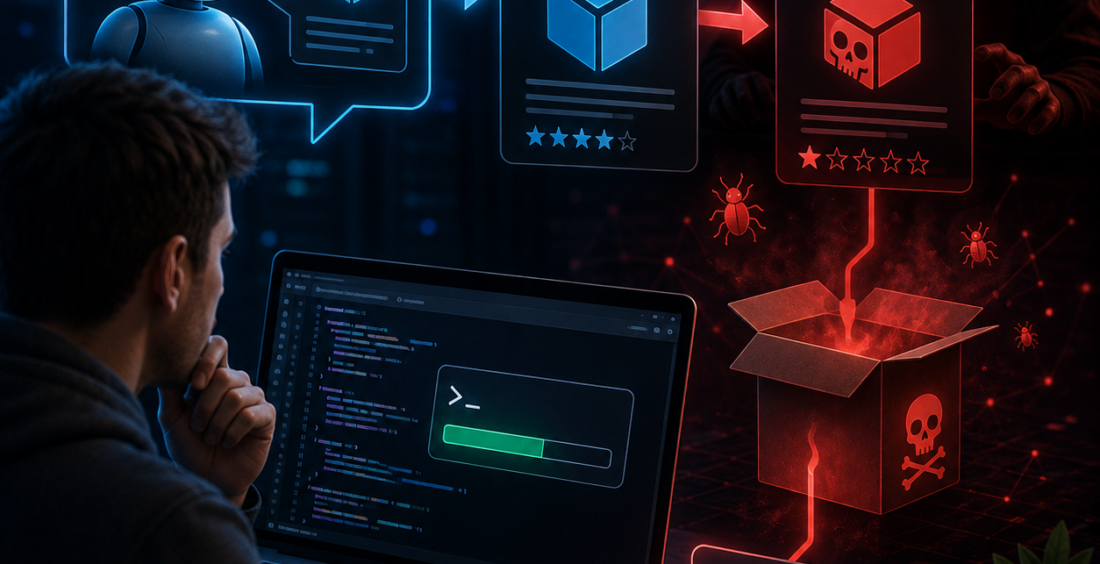
Slopsquatting is an emerging cybersecurity risk created by an unusual combination of AI hallucinations and software package ecosystems.
Developers increasingly ask AI coding assistants to suggest libraries, frameworks and dependencies. Sometimes the assistant recommends a package that does not actually exist. An attacker can register that invented name, publish a malicious package and wait for someone to install it.
The recommendation appears to come directly from a trusted AI coding tool.
How Slopsquatting Starts
AI coding tools are good at predicting what useful code or package names might look like. They are not perfect at knowing whether every suggested package is real.
An assistant might confidently tell a developer to install a library with a believable name. If the developer assumes the recommendation has been checked, they may copy the installation command without visiting the official package page or repository.
OWASP now describes this pattern as slopsquatting: attackers register package names that coding models are likely to hallucinate and use those names to distribute malicious software.
The weakness is not just the AI. It is the trust placed in its answer.
A Package Name Can Look Completely Normal
Software ecosystems contain millions of packages, many with similar names.
That makes a fake dependency easy to overlook. A package called “fast-data-parser” or “cloud-auth-helper” may sound perfectly reasonable to someone working quickly.
An attacker does not need the package to become famous. They only need a small number of developers to install it.
Once installed, malicious code could try to steal environment variables, credentials, API keys or other information available during development.
In a business environment, one careless installation can reach far beyond a single laptop.
AI Makes the Old Supply Chain Problem Different
Malicious packages existed before generative AI. Attackers have long used techniques such as typosquatting, where a package name is designed to resemble a legitimate one.
Slopsquatting adds a new twist.
Instead of waiting for a developer to mistype a known package, the attacker bets that an AI system will invent the same nonexistent name for multiple users.
If that prediction is right, the AI can unintentionally direct developers toward the attacker’s package.
OWASP’s NPM Security Cheat Sheet specifically warns that attackers can monitor hallucinated package names and publish malicious packages under those names.
Developers Need to Verify Dependencies
The safest habit is also one of the simplest: do not install a package only because an AI assistant suggested it.
Developers should confirm that a dependency exists, check its official repository, review who maintains it and look at whether the project has a credible history.
A package created yesterday with little documentation deserves more scrutiny than a mature library maintained by a known project.
Teams can also use approved dependency lists or internal registries so developers are less likely to pull unknown packages directly into sensitive projects.
Verification may take a few minutes. Cleaning up a compromised development environment takes much longer.
Automated Coding Agents Raise the Stakes
The risk becomes more serious when an AI assistant can act instead of merely suggest.
An autonomous coding agent may edit dependency files, run package managers and execute tests without a developer approving every command.
That is convenient, but it gives the agent a direct path from recommendation to installation.
Organizations should limit which repositories and tools coding agents can access. New dependencies should trigger review before they enter production or receive access to secrets.
Automation should remove repetitive work, not remove the security checkpoint that asks whether a new component can be trusted.
Package Managers Need Their Own Guardrails
Security teams can reduce exposure by scanning dependencies before they are used.
Software composition analysis, lock files, secret scanning and repository policies can help identify unexpected or risky packages. Private registries can also give companies more control over which dependencies are allowed.
These controls are useful because people will occasionally miss something, especially when they are moving quickly.
Good cybersecurity does not depend on every developer making a perfect decision every time.
It adds layers so one mistaken installation does not automatically become a serious breach.
Treat AI Suggestions as Suggestions
AI coding assistants can save developers significant time. Slopsquatting is not a reason to stop using them.
It is a reason to change the level of trust given to their recommendations.
Generated code should be reviewed. Suggested packages should be verified. New dependencies should be treated as software entering the company, not as harmless text produced by an assistant.
The key question is simple: “Does this package actually come from the project we think it does?”
As AI becomes a normal part of development, that small check can prevent an invented name from becoming a very real cybersecurity problem.
Contributed by GuestPosts.biz
Further Reading: Cyber Gear Thought Leadership Series







Comments are closed.