
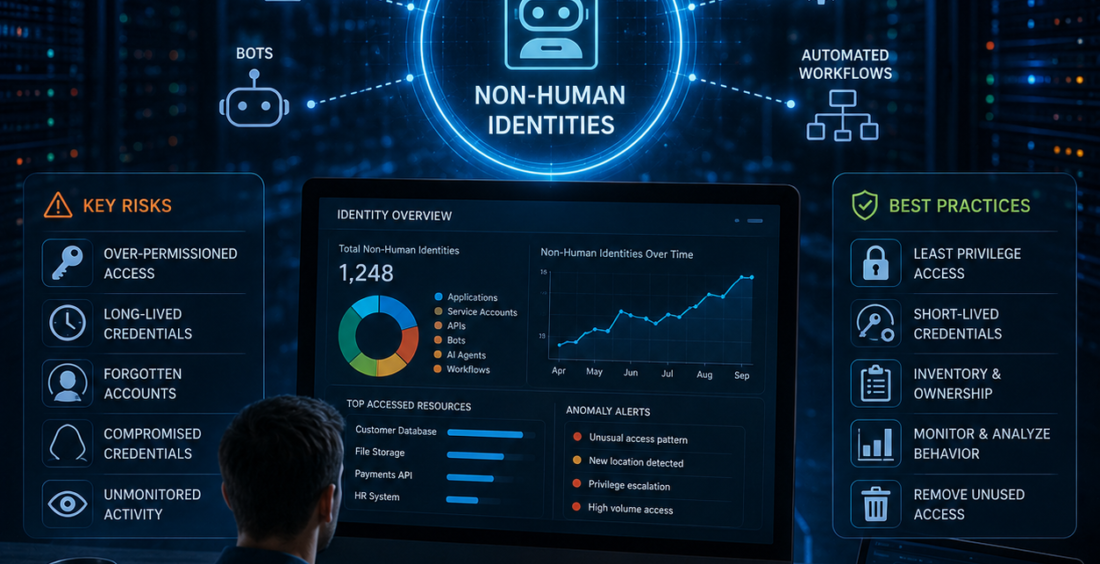
Non-human identities are becoming part of everyday business technology. Applications use service accounts, cloud workloads rely on credentials, APIs connect systems, and AI agents act on behalf of employees.
The problem is scale. Many machine identities can reach sensitive systems without anyone noticing them during a normal workday. As automation grows, cybersecurity teams need to know not only which people have access, but which machines, bots and agents do too.
What Counts as a Non-Human Identity?
A non-human identity is simply a digital identity used by software rather than a person.
It might belong to an application that connects to a database, an automated script that moves files, a cloud workload, a bot, or an AI agent completing tasks across several business systems.
These identities need permissions for legitimate reasons. A billing application cannot process invoices without financial data, and an AI assistant cannot schedule meetings without calendar access.
The challenge begins when those permissions are broader or longer-lasting than necessary.
The Access Nobody Thinks About
Human accounts usually receive attention as employees join, change roles and leave. Machine accounts are easier to forget.
A service account created for a project may exist years later. An API key may be copied into several systems. A bot may keep administrator rights to avoid interrupting a workflow.
Over time, forgotten access builds up.
If an attacker steals one of those credentials, they may gain trusted access without logging in as an employee. The activity may be harder to spot because automated accounts work in the background.
AI Agents Make Identity More Important
Agentic AI adds another layer to the problem.
Unlike a simple application, an AI agent may choose tools, move between systems and act toward a goal. It could search documents, update customer records, send messages or trigger another application.
That flexibility makes permissions especially important.
NIST is actively exploring standards-based approaches for identifying and authorizing software and AI agents. OWASP also lists identity and privilege abuse among the major security risks facing agentic applications.
The question is straightforward: what can this agent do if something goes wrong?
Credentials Should Not Live Forever
One common problem with non-human identities is long-lived credentials.
A password, token or API key may remain valid for months or years. That is convenient, but risky.
If the credential is exposed in code, a configuration file or a compromised system, an attacker may be able to reuse it.
Shorter-lived credentials reduce that window. Organizations should also rotate secrets, remove credentials that are no longer needed and avoid embedding them directly inside source code.
The idea is simple: access should expire when the need for it expires.
Give Machines Only What They Need
The principle of least privilege applies to machines just as much as people.
A reporting tool that only reads sales data does not need permission to delete records. A chatbot that answers employee questions does not need administrator access to the entire company network.
Permissions should match the job.
This matters even more for AI agents because their actions can change depending on the task. High-risk actions, such as transferring money, deleting data or changing security settings, may deserve additional approval.
Good cybersecurity is not about stopping automation. It is about putting sensible limits around it.
Monitoring Machines Requires Context
Machine activity can be noisy. Automated systems may make thousands of requests while people make only a few.
That means traditional monitoring is not always enough.
Security teams need to understand what normal behavior looks like for important non-human identities. If a backup account suddenly accesses customer records, or an AI agent starts using tools outside its usual workflow, that change should attract attention.
Logging helps answer basic questions after an incident: which identity acted, what did it access, what credentials were used and what happened next?
Without that visibility, investigations quickly become guesswork. That visibility matters before an incident, not only afterward.
Identity Is No Longer Just About People
For years, identity security focused mainly on employees, contractors and administrators. That model is changing.
Businesses now depend on software identities that operate constantly and often hold significant privileges. AI agents will make that environment even more dynamic.
The answer is not to treat every machine account as a crisis. It is to manage non-human identities with the same discipline applied to important human accounts.
Know what exists. Give each identity a clear purpose. Limit its permissions. Use credentials that can expire. Monitor unusual behavior and remove access when it is no longer needed.
The future of identity security is not human or machine. It is both.
As organizations automate more work, the quiet accounts running behind the scenes deserve far more attention today than they used to receive.
Contributed by GuestPosts.biz
Further Reading: Cyber Gear Thought Leadership Series







Comments are closed.