
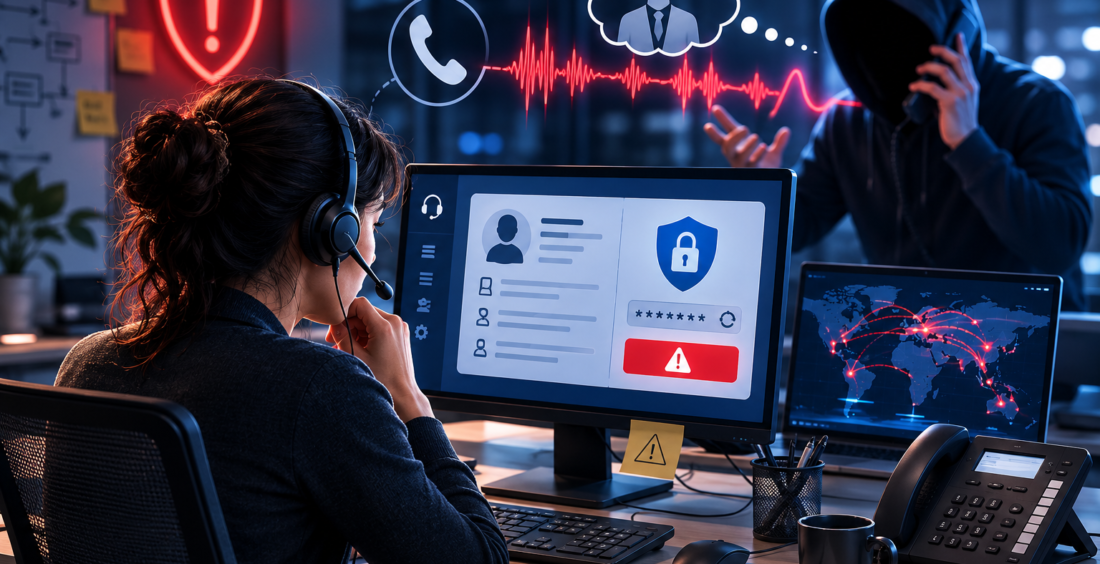
Help desk social engineering is becoming a cybersecurity problem because attackers have learned that the easiest way around security controls is to convince a person to change them.
Instead of breaking encryption or exploiting a software flaw, an attacker can call support, pretend to be an employee and ask for a password or multi-factor authentication reset.
If the request sounds convincing, the help desk may unknowingly open the door.
Why Help Desk Social Engineering Works
Help desks are designed to solve problems quickly. Employees call when they are locked out, lose a device.
Attackers understand that pressure.
They may research a target on LinkedIn, company websites or leaked data. Knowing an employee’s title, manager or department can make the story sound believable.
Mandiant reported in its 2026 M-Trends research that highly interactive voice phishing rose to 11 percent of observed initial infection vectors, becoming the second most common method in its investigations.
The attack works because it targets trust and process rather than technology.
A Password Reset Can Change Everything
A password reset may seem like a support task. In the wrong hands, it can become the first step toward a larger breach.
Microsoft documented a 2026 campaign in which attackers abused self-service password reset processes and used social engineering to persuade users to approve MFA prompts. After gaining control, the attackers removed authentication methods and registered their own.
That is important because the attacker is not simply stealing a password. They are trying to become the identity.
Once that happens, cloud applications may treat them like the employee.
MFA Is Strong Until Someone Resets It
Multi-factor authentication remains one of the most useful protections against account takeover.
But every authentication system needs a recovery process.
People lose phones, forget passwords and replace devices. If the recovery process is weaker than the normal login process, attackers will target recovery instead.
A help desk should therefore treat an MFA reset as a high-risk identity event, not a routine administrative request.
The question should not be, “Does this caller know enough information about the employee?”
Much of that information may already be public.
Verification Needs More Than Personal Questions
Help desk verification may ask for an employee number, manager name, date of birth or other personal information.
Those checks are becoming less reliable.
Attackers can collect personal details from social media, data breaches and company information. AI tools can also help criminals organize that information and create a convincing story.
Sensitive resets should use verification methods that are difficult for an attacker to reproduce.
That might include confirmation through a known company device, a separate trusted channel or another identity method connected to the employee.
The caller should not be allowed to choose the verification method that is easiest to defeat.
Urgency Should Be a Warning Sign
Help desk staff are under pressure to restore access quickly.
An attacker may use that pressure. They may claim to be traveling, preparing for a meeting or unable to complete an urgent financial task.
The story is designed to make the support agent feel responsible for solving the problem immediately.
Security procedures need to remain consistent when a caller sounds important or frustrated.
A senior title should never become a shortcut around identity verification.
Watch What Happens After the Reset
Prevention matters, but monitoring can catch an attack that gets through.
A password or MFA reset followed by a login from an unusual location deserves attention. So does the registration of a new authentication method followed by downloads or unexpected access to cloud services.
Microsoft’s 2026 research showed attackers moving from identity compromise into Microsoft 365 and Azure, where they searched for sensitive information and downloaded large numbers of files.
Security teams should connect identity events with what happens next instead of viewing a reset as an isolated support ticket.
The Help Desk Is Part of Cyber Defense
Help desk employees are sometimes treated as customer service staff who happen to work in IT.
That view needs to change.
They sit at a point between users and the systems that protect identity. A single reset can affect email, cloud storage, finance tools and other connected applications.
That makes the help desk part of the cybersecurity team, even if that is not written in the job title.
Staff need clear procedures, training and permission to slow down a suspicious request.
Attackers are becoming more comfortable using conversation instead of code. They know that a friendly voice, a convincing story and urgency can sometimes achieve what malware cannot.
The best defense is not making help desks less helpful.
It is making sure that helping the wrong person does not become the easiest way into the company.
Contributed by GuestPosts.biz
Further Reading: Cyber Gear Thought Leadership Series







Comments are closed.