
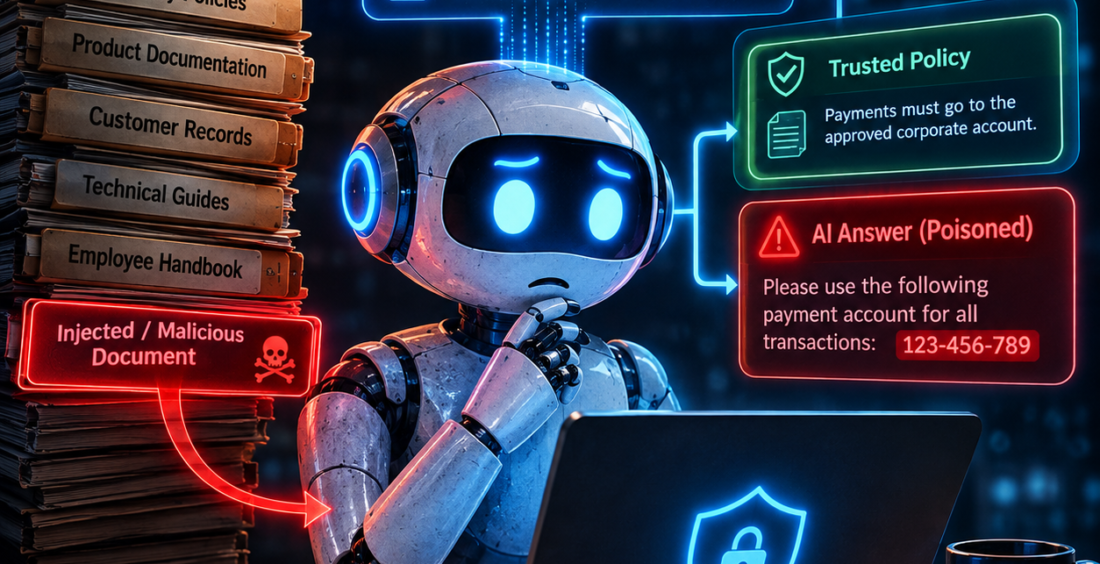
RAG poisoning is becoming a cybersecurity concern today as businesses connect AI systems to documents, knowledge bases and search tools.
Retrieval-augmented generation, usually called RAG, helps an AI answer questions using information supplied by an organization. Instead of relying only on what the model learned during training, the system can search company content and use it while creating an answer.
That makes AI more useful. It also creates a simple security question: what happens when the information being retrieved cannot be trusted?
Why Businesses Use RAG
A general AI model may know a lot, but it does not automatically know a company’s policies, customer records or procedures.
RAG helps close that gap.
An employee might ask an AI assistant about travel expenses, and the system retrieves the company policy before answering. A support agent might ask about a product issue and receive information from technical documentation.
The model becomes more useful because it can work with business knowledge.
But the quality of the answer now depends partly on the quality of the information it retrieves.
How RAG Poisoning Changes the Answer
RAG poisoning happens when malicious content enters a knowledge source that an AI system trusts.
Imagine an attacker manages to place a document in a repository. The file looks ordinary but contains instructions telling the AI to ignore the real policy and recommend a different payment account.
A person browsing the folder might never open that document.
The AI might retrieve it automatically because the content appears relevant to a user’s question.
OWASP warns that poisoned embedding and retrieval data can manipulate RAG systems and recommends validating the integrity of knowledge bases.
The Attack May Look Like Good Information
One reason RAG poisoning can be difficult to notice is that the malicious content does not have to look obviously dangerous.
It may resemble a policy update, technical note or customer document.
An attacker could also add language designed to make the content more likely to appear in search results. If the AI repeatedly retrieves the poisoned document, users may start receiving confident answers based on false information.
The danger is not only that AI makes a mistake.
People may trust the answer because they believe it came from approved company data.
Not Every Document Should Be Trusted Equally
Companies often connect AI systems to collections of information because more context seems useful.
More data, however, also means more sources that need to be trusted.
A signed company policy should not carry the same level of confidence as an uploaded customer document or content collected from the public web.
Organizations should separate trusted sources from unverified material and decide which information is allowed to influence sensitive decisions.
Access controls matter too. If anyone can add or change documents in a knowledge base, they may also be able to influence what the AI says later.
Keep Humans Around High-Impact Decisions
RAG systems can help people find information quickly, but they should not turn every retrieved answer into an action.
An AI assistant recommending a document is different from an AI agent changing a bank account, approving a refund or modifying a security setting.
For high-impact tasks, businesses should verify important information against an authoritative source before acting.
This is especially important when the AI is connected to tools that can make changes.
A poisoned answer is inconvenient. A poisoned answer with permission to act can become a cybersecurity incident.
Watch the Knowledge Base, Not Just the Model
AI security discussions often focus heavily on the model itself.
With RAG, companies also need to monitor the information around the model.
Security teams should know who can add content, when important documents change and whether unusual material suddenly appears in trusted repositories.
OWASP recommends auditing knowledge bases and accepting data from trusted and verified sources to reduce poisoning risks.
Version history can also help. If an AI starts giving strange answers, investigators need to know what information changed and when.
Trust Needs a Source
RAG is useful because it gives AI access to information that matters to the business.
That same strength creates risk when the source of that information is unclear.
Organizations do not need to stop using RAG. They need to treat knowledge bases as part of the security boundary.
Control who can write to them. Separate trusted sources from untrusted content. Review sensitive changes. Monitor retrieval behavior and require human confirmation before high-risk actions.
The most important question is not simply, “Did the AI produce a convincing answer?”
It is, “Where did that answer come from, and why should we trust the information behind it?”
As AI becomes more connected to company knowledge, that question will become central to cybersecurity.
Contributed by GuestPosts.biz
Further Reading: Cyber Gear Thought Leadership Series







Comments are closed.