
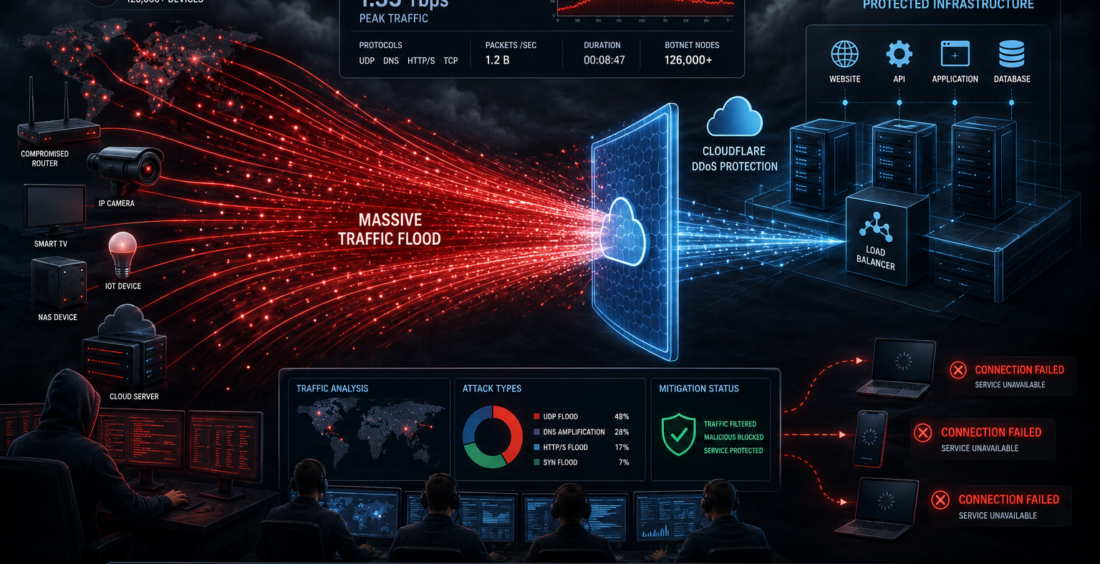
DDoS attacks remain one of the most direct ways to make an online service unavailable. Instead of stealing data, attackers overwhelm websites, APIs or networks with more traffic than they can handle.
The idea is simple. The scale is not.
Modern botnets can unite compromised routers, cameras and servers, then direct them at one target.
That makes DDoS a serious cybersecurity issue for online businesses.
Why DDoS Attacks Still Matter
A DDoS attack does not always need to break into a system. Its goal may be to make a service slow or unavailable.
For an online retailer, customers may be unable to check out. A bank may lose access to digital services. An overloaded API can disrupt software customers.
The impact can arrive quickly without data theft.
Cloudflare reported a sharp rise in hyper-volumetric attacks during the first half of 2026, including hundreds exceeding one terabit per second.
Botnets Turn Ordinary Devices Into Attack Tools
Many large DDoS attacks depend on botnets.
A botnet is a collection of compromised devices controlled by an attacker. The owner of an infected router or camera may have no idea their device is being used in an attack.
Attackers often look for devices with weak passwords, outdated software or exposed services. Once compromised, those devices can be instructed to send traffic toward the same destination.
One device may not create much pressure. Thousands working together can.
That makes poorly secured internet-connected equipment a problem beyond the place where it sits.
Biggest Does Not Always Mean Most Dangerous
Record-breaking DDoS attacks attract headlines because the numbers are dramatic.
But businesses should not assume only enormous attacks matter.
A smaller attack aimed at a fragile application, login page or API can create disruption. Application-layer attacks may imitate normal user requests, making them harder to separate from legitimate traffic.
Microsoft explains that DDoS defenses need to address both network floods and application-layer attacks targeting web services.
The important question is not how large an attack looks. It is whether the service can remain available while the attack is happening.
Short Attacks Can Still Cause Damage
DDoS attacks do not need to last for hours to be effective.
Cloudflare says most attacks it mitigated in early 2026 were short, even as very large attacks became more common.
That challenges slow response processes.
If a team needs twenty minutes to decide whether traffic is malicious, an automated attack may already have caused disruption and stopped.
Protection needs to work quickly, without depending on someone manually noticing every traffic spike.
Availability Needs to Be Designed In
DDoS protection works best when it is part of the architecture rather than something added during an emergency.
Businesses can distribute traffic, use content delivery networks, apply rate limiting and place specialized DDoS protection in front of public services.
Web application firewalls can also help with application-layer attacks by identifying unusual request patterns.
The right controls depend on the service. An internal portal and a global ecommerce site do not need the same design.
What matters is understanding which online services are critical and how much disruption the business can tolerate.
Do Not Forget the Origin Server
A company may protect its public website through a cloud security provider but leave the origin server reachable directly from the internet.
If attackers discover that address, they may try to bypass the protection layer and attack the origin itself.
Public services should be configured so traffic reaches them through intended security controls wherever possible.
The same principle applies to internet-facing systems.
A strong front door is less useful when there is an exposed side entrance.
DDoS Is Also an Incident Response Problem
Even good protection does not remove the need for planning.
Teams should know who contacts the hosting provider, cloud platform or DDoS protection service during an attack. They should understand which systems are important and how customers will be informed if a service becomes unavailable.
Testing those decisions before an incident makes the response faster.
Security, infrastructure, communications and business teams may need to work together during serious disruption.
Availability Is Part of Cybersecurity
DDoS attacks are sometimes treated as a nuisance because they may not involve stolen passwords or encrypted files.
That understates the risk.
For businesses built around online services, availability is part of security. A system that is confidential but unavailable to every customer is still failing.
Powerful botnets mean organizations should expect DDoS attacks to keep changing in size, speed and technique.
The question is not only, “Can our network absorb a huge attack?”
It is, “Can our most important service stay useful while someone is deliberately trying to overwhelm it?”
That is the resilience DDoS security needs to deliver.
Contributed by GuestPosts.biz
Further Reading: Cyber Gear Thought Leadership Series







Comments are closed.