
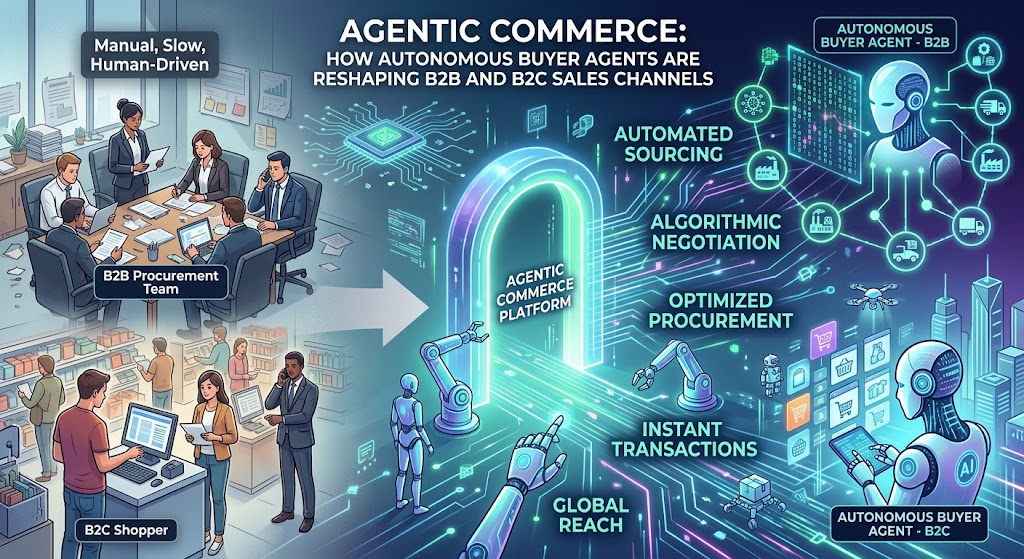
For nearly thirty years, digital commerce platforms were built for humans. Retailers and wholesale suppliers dedicated resources to building beautiful landing pages, writing engaging product descriptions, intuitive menu structures to drive the human eye toward a “checkout” button, and a myriad of other design choices to persuade the conscious mind. Search Engine Optimization (SEO) reigned supreme, as it provided digital shops with the best chance to appear at the top of search result rankings.
However, as personal buying agents and corporate procurement bots emerge, websites and digital stores are no longer being judged by their appeal to humans. Purchases are being made by robots, and the rules of engagement have changed. We have entered the “Machine-as-Customer” economy.
The Buying Agent Economy: From Pretty Web Pages to Product Specifications
A buying agent will approach a potential purchase differently than a human would. While a human might be wooed by a brand’s color palettes and clever marketing taglines, a buying agent is likely to be more receptive to structured information such as whether or not the desired product has an API with dynamic inventory availability, specification matching, volume pricing, guaranteed stock quantities, and return policies.
Any merchant that cannot provide this level of detail and execute a purchase on an agent’s behalf, programmatically-speaking, will find themselves increasingly invisible to an automated buying economy. SEO (search engine optimization) has entered its next phase: Agent Engine Optimization, or AEO.
Open Commerce Protocols for Autonomous Software Agents
In order to facilitate these next-generation transactions, major technology companies are standardizing open commerce protocols that allow buying agents to discover products, match specifications, and perform payments seamlessly:
The Universal Commerce Protocol (UCP) defines a set of machine-to-machine instructions throughout the entire buying process (from discovery to checkout). With a standardized set of instructions, buying agents can query bulk pricing, inventory availability across geos, and complete purchases with vendors while reducing the need for traditional “web pages.”
Security, fraud prevention, and tokenization capabilities
With the opening up of commerce endpoints to autonomous agents, it is now even more crucial to secure payment platforms from abuse while also protecting agents from fraudulent activity. By utilizing strong identity verification, transaction limitations, tokenization, and fraud monitoring tools, merchants can ensure that automated agents are able to settle valid charges programmatically, while buyers are protected from misleading product information designed to bait out human shoppers.
As agent commerce matures, a significant portion of enterprise sales operations will begin to revolve around technical data availability and not webpage-level design.
Agentic Commerce Protocol (ACP): Checkout and Shared Payment Tokens
While the focus of the Universal Commerce Protocol is on discovery, Agentic Commerce Protocol (ACP), ACP provides standardized measures for checkout, including Shared Payment Tokens (SPT). SPTs serve as limited-use, amount-limited, and agent-specific encryption tokens that only a buying agent can use to settle charges with a merchant.
Trusted Agent Protocol (TAP): Card settlement and payment networks
The Trusted Agent Protocol (TAP) allows agent buyers to tokenize and settle directly into major card payment networks, and includes fraud prevention and chargeback measures designed specifically for autonomous agents.
Transforming B2B Sales & Supply Chains With Agent Commerce
While agent commerce platforms are increasingly being embraced by individual consumers, the real opportunity lies in the wholesale space. The ability for companies to connect buying agents directly into selling platforms and ERP systems will disrupt traditional supply chains.
In the future, enterprise procurement teams will utilize autonomous agents to scan their inventory levels and identify which products require replenishment. For example, if an automotive manufacturer notices a shortage of a particular type of rare metal in their warehouses, their buying agent can be tasked with scanning the marketplace for RFQs (Request For Quotation) from certified suppliers.
These suppliers, in turn, can utilize their own agent platforms to specify their product’s pricing, CO2 emissions, and estimated lead times. The buying agent can then analyze this data and allocate a purchase order to the most competitive seller, utilizing a Shared Payment Token. This entire process, which previously could take days or weeks, can be completed in a matter of seconds by autonomous agents.
Companies that wish to participate in this new economy and unlock real-time B2B commerce should explore enterprise agent technologies.
Contributed by GuestPosts.biz
Further Reading: Cyber Gear Thought Leadership Series







Comments are closed.