
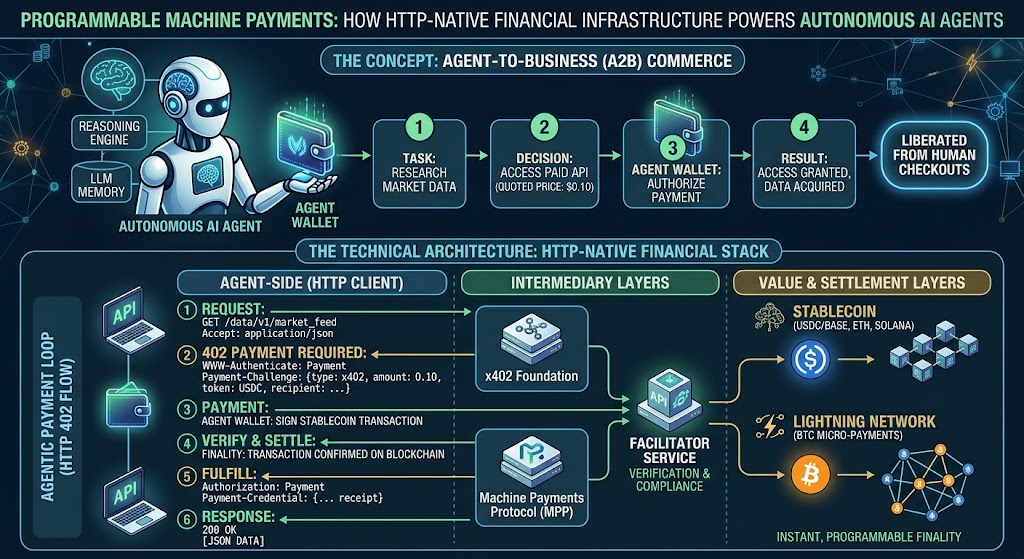
As autonomous AI agents take on more responsibilities across business workflows—renting cloud compute cycles, querying paid API endpoints, and procuring digital assets—they encounter a fundamental infrastructure hurdle: legacy financial systems. Traditional payment networks, such as credit cards, ACH transfers, and SWIFT bank wires, were built entirely for human interaction. They incur fixed processing surcharges, take days to settle transactions, depend on visual web interfaces, and expose primary credit credentials to security risks.
An autonomous software agent does not operate on a human monthly billing cycle. When managing complex multi-step processes, an agent might need to execute thousands of micro-transactions per minute—paying $0.0002 for a specialized search query, $0.0015 for three seconds of GPU compute, or $0.05 for a real-time data feed. Running high-frequency micropayments through traditional card networks is financially unfeasible due to minimum processing fees. To operate effectively, the machine economy requires programmable, zero-trust financial infrastructure built directly into standard web protocols.
The Revival of HTTP 402 and the x402 Standard
The need for machine-native settlement has led to the revival of a long-reserved web status code: HTTP 402 Payment Required. Originally set aside during the early development of the internet, HTTP 402 is now being utilized to establish direct, pay-per-call API monetization for autonomous agents.
Under payment standards like the x402 protocol, when an AI agent requests access to a paid API or data resource, the server immediately responds with an HTTP 402 header. This response specifies the exact cost per call, the recipient’s digital wallet address, and the supported payment asset (typically stable coins like USDC operating on high-speed Layer-2 networks). The requesting agent checks its local budget parameters, cryptographically signs a payment payload, and attaches the proof of payment to a retry header (X-PAYMENT-PROOF). The server verifies the signature in milliseconds and streams the requested data.
Streaming Micropayments and Machine Payment Credentials
Beyond single-call micropayments, long-running agentic tasks require continuous financial authorization. When an autonomous agent performs continuous data analytics or trains machine learning models over extended periods, signing individual payment transactions for every second of execution creates unnecessary protocol overhead.
To solve this, modern machine payment architectures utilize streaming payment rails like the Machine Payments Protocol (MPP). Under an MPP framework, an agent opens a pre-authorized streaming session backed by a secure escrow account. As compute cycles are consumed, micro-funds stream continuously from the agent’s balance to the resource provider. If execution halts or an error occurs, the payment stream terminates instantly, protecting both parties from payment defaults or overcharges.
Concurrently, financial networks are introducing specialized credentials like Agent Pay for Machines (AP4M). These protocols issue cryptographic Verifiable Intent credentials linked to enterprise bank accounts, allowing corporate treasuries to set strict daily spending limits, merchant category restrictions, and single-transaction caps directly on an agent’s digital wallet.
Key Isolation, Security, and Risk Management
Granting software agents direct access to financial assets requires rigorous security architecture. If private wallet keys are stored insecurely in an agent’s memory, prompt injection attacks or code vulnerabilities could allow malicious actors to exfiltrate funds or execute unauthorized transfers.
To protect machine financial infrastructure, enterprise IT teams isolate private transaction keys inside Hardware Security Modules (HSMs) or secure enclaves. Agents interact with transaction managers that validate requested payments against strict policy rules before signing payloads. Furthermore, automated circuit breakers monitor transaction frequency to prevent recursive logic loops from accidentally draining balance reserves. Implementing robust governance models with enterprise AI Agent frameworks ensures that autonomous financial operations remain secure and audit-compliant.
As HTTP-native micropayments and streaming financial rails continue to mature, traditional software monetization will undergo a major evolution. Flat monthly SaaS subscriptions will increasingly give way to hyper-granular, pay-per-value pricing models managed autonomously by machine-native payment networks.
Contributed by GuestPosts.biz
Further Reading: Cyber Gear Thought Leadership Series







Comments are closed.