
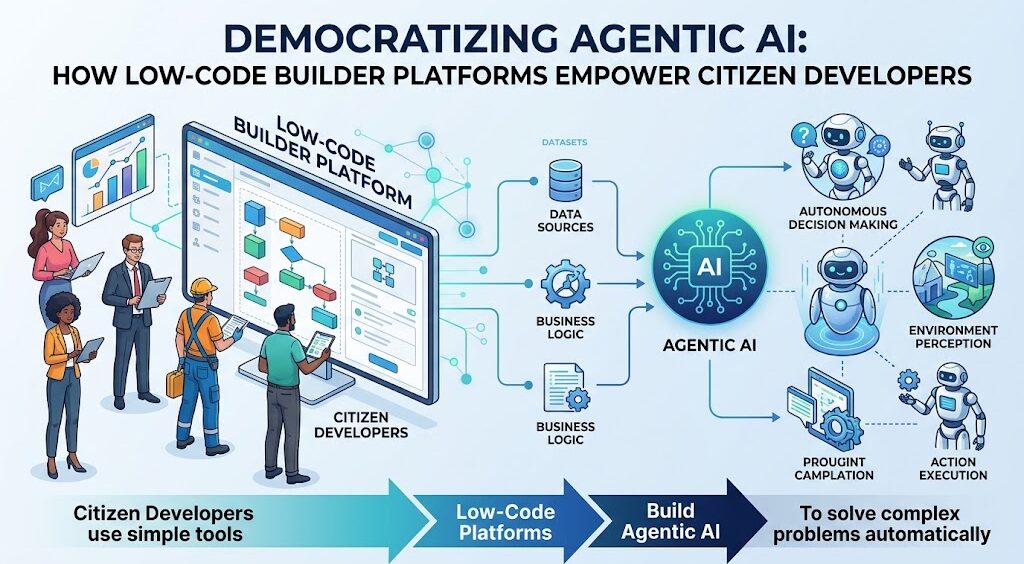
In the early days of agentic AI, one had to have a team of software engineers to design a multi-agent system that would fulfill the use case. Developers had to write bespoke python or typescript code, design vector databases for retrieval-augmented generation (RAG), and implement state-of-the-art orchestration frameworks for managing transitions between states. Such technical complexity created intolerable delays for the line of business users who knew the operational domain better than the IT organization. For example, HR business analysts, procurement officers, and other domain experts had to wait for months before they could see even simple automations that would reduce their manual effort in day-to-day operations.
This challenge is being addressed by the recent rise in low-code and no-code agent builder platforms. The modern visual builder environments allow citizen developers to design and train domain-specific agents in a matter of minutes. Using visual prompts, configuration panels, and natural language instructions, operational staff can implement visual workflows that employ decision-making logic, database access, and third-party tool interaction.
Visual Agent Builder Environments Provide Citizen Developers With End–to-End Infrastructure Automation
The modern low-code builder environment provides all the features necessary to implement an agentic AI system. Instead of manually writing API request headers or database query instructions, the citizen developer uses intuitive visual tools to define triggers and connect them to decision nodes and database queries. For example, a logistics manager can design an agent that gets triggered by new delivery exceptions and use it to check warehouse inventory and carrier rates. The builder connects the agent to necessary tools using standard authentication mechanisms and business logic nodes such as spending limits UI toggles. The developed agent can then be tested in an automated sandbox environment. Companies interested in enabling their business analysts to automate routine tasks can consider no-code agent development platforms that provide end-to-end infrastructure for citizen developers.
Low-code Democratization of Agentic AI
The most significant benefit of low-code platforms lies in giving domain experts the ability to implement agents that solve their unique challenges. When building an agent in code, generic software developers may not have the domain knowledge to implement all the use cases that the operational analyst would need. For example, a senior HR business analyst knows exactly what should happen in the employee onboarding system if an unusual situation breaks the regular process. By developing the agent themselves, analysts can implement such unique logic in their automated processes. For example, an HR analyst can build an onboarding agent that would handle equipment issuance, orientation scheduling, and benefits enrollment. Similarly, a field service manager can design an automated field technician routing agent that uses traffic information and emergency job alerts to make routing decisions. Partnering with a custom AI agent development provider can give organizations the infrastructure they need to enable the business analysts to develop their own agents.
Enabling Self–Serve Agent Development Could Result in Shadow AI and Governance Issues if Not Properly Governed
Giving non-technical business analysts access to tools that let them build their own software agents can pose significant governance and security challenges to enterprise IT. When self–serve AI agent builder platforms enable shadow IT, enterprise IT security teams could find themselves in a situation where company data is being accessed by unauthorized third-party services. For example, a misconfigured analytics agent could expose a financial database to an unauthorized external data visualization tool. To prevent such security breaches, enterprise IT should implement Center for Platform Governance Sandboxes.
IT departments can design platform governance sandboxes that give business users the freedom to experiment while minimizing exposure to production data and services. The IT organization can define infrastructure-level privacy controls, proxies, and access points while letting the business analysts experiment with proxies, tools, and rules within the sandboxes. Such a policy lets the citizen developers bring their innovation to the company while ensuring that enterprise IT remains in control of the agent infrastructure. Using enterprise–grade AI Agent platforms can give companies the freedom to develop their own agentic solutions within a secure infrastructure sandbox.
Low-code builder platforms are a vital step toward democratizing artificial intelligence. By combining the domain knowledge of business analysts with low-code infrastructure, organizations can scale their automation initiatives at an unprecedented level. However, such democratization should be accompanied by appropriate platform-level governance and security sandboxes.
Contributed by GuestPosts.biz
Further Reading: Cyber Gear Thought Leadership Series







Comments are closed.