
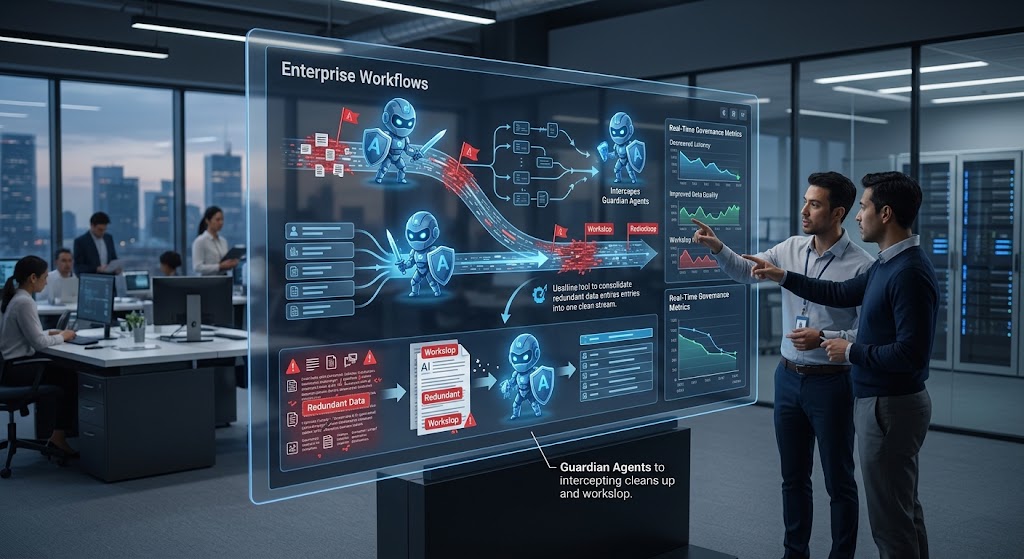
As enterprise AI agents evolve from assistants to autonomous actors that change software state, execute code, and make financial transactions, executive leadership must consider governance. Allowing software networks to self-govern provides enormous productivity gains, but carries substantial exposure: untrusted execution, exfiltration of contextual information, and accumulation of poor quality autonomous work, often called “workslop” in enterprise software circles
Workslop takes many forms including data payloads, natural language text, and code that appear correct on first inspection, but contain subtle contextual errors or hallucinated facts. Once this autonomous workslop enters production databases, ERP financial systems, or customer communication channels, human workers must waste time auditing and undoing the autonomous changes.
The Hidden Cost of Untrustworthy Autonomous Software
This loss of control and quality is a significant risk that explains why most non-executive workers do not trust autonomous agents to execute unreviewed actions
Many coders are already embracing “vibe coding” where they accept unreviewed contributions from AI coding partners. This practice typically embeds unchecked input parameters, compromised secrets, and insecure third-party dependencies directly into production code repositories.
The Trust Gap in Autonomous Coding Practices
While most executive leadership trusts AI agents to handle core business processes, this perception does not align with reality- most salaried workers would refuse to let an autonomous software agent make unreviewed code commits due to the risk of workslop.
How Guardian Agents Provide Inline Security Proxy Functions
Modern enterprise software is responding to these reliability and security concerns with a new class of lightweight guardians called Guardian Agents. These assistants act as inline security proxies for other enterprise AI agents, software tools, and communication middleware
By designating specific agents to perform proxy security functions, enterprises can establish a robust auditing trail while reducing the risk surface for workslop injection
Guardian agents enforce security and quality control across four primary inspection layers:
Payload Validation and Schema Auditing
Context Scrubbing and Data Loss Prevention
Static Code Auditing and Sandboxing
Policy Boundary Checks
When an execution agent prepares to call an external tool or service, guardian agents validate the JSON payload against schema rules, parameter restrictions, budget limits, and business logic constraints before allowing the request to proceed
Before sending any data to an external tool or agent, the guardian agent examines the payload for PII, intellectual property, and secret credentials, removing prohibited data items
The guardian agent acts as a static code analysis proxy, inspecting coding agent output for first-party and third-party security weaknesses prior to deployment
When evaluating the proposed action, the guardian agent checks if the action violates any enterprise policy manifest or financial control lists
Enterprises can request implementation assistance from AI agent security specialists to establish inline inspection processes within their agent coordination framework.
Enforcing Auditable Contextual Boundaries for Autonomous Tools
Guardian agents also help enterprise software environments achieve the auditable context boundaries required by SOC 2, HIPAA, and the EU AI Act regulations
When an autonomous agent performs complex operations, regulators and internal auditors must be able to understand the rationale for each step. Guardian agents create comprehensive audit trails by recording all decision trees, prompting contexts, tool responses, and safety scores to append-only cryptographic log files.
When an agent performs unexpected operations, security analysts can examine the exact prompting context and tool responses to determine what operational changes were available to the agent at each decision point.
By implementing these contextual auditing capabilities with enterprise AI agent environments, organizations can ensure their autonomous tools follow approved operations, while creating the necessary evidence for external security audits.
Real-Time Security Proxies Enable Executive Trust in Autonomous Enterprise
Within the next five years, enterprise software environments will feature real-time governance proxies that give executive leadership the confidence to delegate operational responsibility to autonomous software agents
By enforcing safety guardrails before autonomous outputs reach production, guardian agents lower risk across the organization, enabling executives to realize the productivity gains from adopting agentic MaaS infrastructure.
Contributed by GuestPosts.biz
Further Reading: Cyber Gear Thought Leadership Series







Comments are closed.