
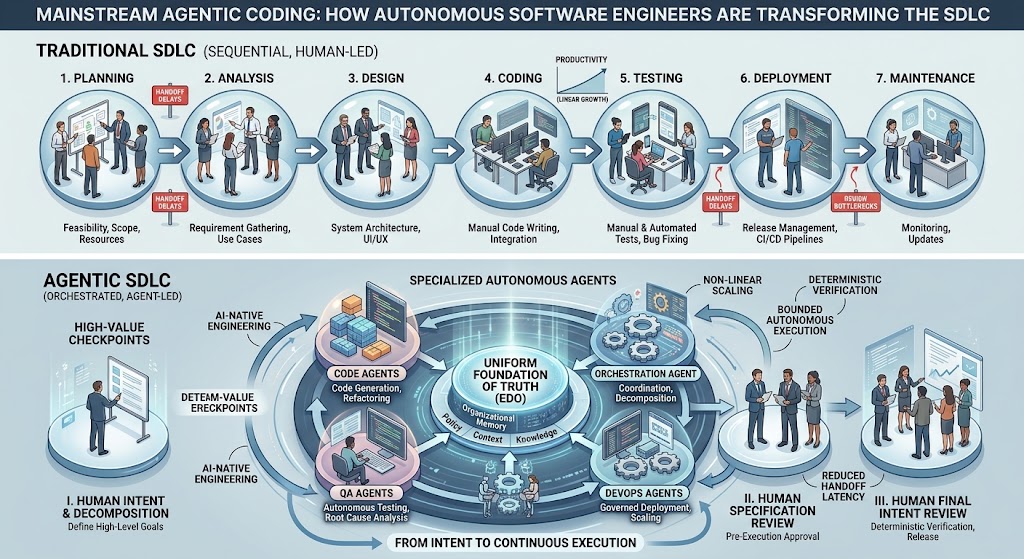
Software development was among the first fields to be transformed by modern generative AI. The earliest code completion tools were contextual assistants that worked inline within a developer’s IDE. These tools did not replace human programmers but rather accelerated day-to-day boilerplate coding tasks.
A developer still had to manually traverse repository structures, debug runtime exceptions, author integration test specifications, and manage pull request lifecycle states.
The emerging paradigm shift in enterprise software development centers around contextually intelligent coding assistants that function as self-governing developer agents.
When presented with a high-level natural language description of a bug or feature, an autonomous coding agent can clone a repository, map dependency graphs, reproduce a bug in an isolated environment, write unit tests, update source code, build binaries, run integration suites, and submit a pull request for code review.
The Mechanics of Autonomous Coding Agents
To better understand their impact, it is helpful to examine what goes into building an autonomous coding agent at the infrastructure layer. Unlike simple IDE extensions, serious coding assistants require tight integration with local development tooling and static analysis sandboxes.
The key technical enablers that make autonomous agents possible include:
Isolated Execution Environments: To perform meaningful code transformations, autonomous agents execute language-specific compilers, linters, and test suites inside sandboxed Docker or WASM runtimes
Abstract Syntax Tree (AST) Mapping: Advanced coding assistants go beyond simple text pattern matching by building AST mappings and graph databases that represent variable and class lineage across codebases
Local Compute Offloading: To maximize performance, agents offload intensive language-specific linting and security audits to local language tooling. Tools like mdlint can analyze a codebase and return only the security vulnerability summary back to the central model.
Practical Applications: From Legacy Modernization to Auto-Patching
Beyond standard IDE assistive features, autonomous coding agents have transformative applications in enterprise software development. Many companies are already leveraging autonomous agents to accelerate internal software development processes.
Take legacy system modernization as an example use case.
There are millions of lines of business-critical software running on legacy platforms such as COBOL or Java EE that few developers understand. An autonomous coding pipeline can be trained on legacy application source code to reverse-engineer business logic and automatically port it to modern cloud-native architectures. The result is a complete microservices refactoring with accompanying test suites and API documentation. Organizations that want to accelerate legacy modernization can work with AI agent development companies to build domain-specific refactoring pipelines.
Another powerful application of autonomous coding agents is implementing zero-day security patching. When new security advisories are released, enterprise security agents can scan internal repositories for vulnerable package dependencies, automatically generate exploit patches, run integration test suites, and submit pull requests to affected repositories. Similar security agent pipelines can be developed for contract auditing in smart chain applications.
Code Governance in Autonomous Software Development
The rise of autonomous coding presents unique technical governance challenges. The proliferation of “vibe coding” – writing code with little understanding of an AI-assisted code’s inner workings – creates opportunities for hidden technical debt to accumulate.
A security-conscious autonomous coding pipeline will implement comprehensive software governance policies to monitor for such vulnerabilities. If a model is trained on insecure code samples, it may inadvertently introduce security weaknesses such as insufficient input validation or hard-coded encryption keys in production-ready code. Effective code governance requires implementing static application security testing (SAST) and container vulnerability scanners for all autonomous agent outputs, alongside human code review process gates. Enterprises that utilize commercial autonomous coding platforms should consider adopting comprehensive governance frameworks provided by enterprise AI agent providers to maximize security and technical debt control.
The Future of Software Development With Autonomous Coding Agents
Autonomous coding agents represent a major paradigm shift in software development. Developers who utilize self-governing coding assistants find themselves spending less time on rote coding tasks and more time on higher-level system design and security reviews. Companies that develop effective human-agent collaboration processes will be well-positioned to accelerate their software development cycles.
Contributed by GuestPosts.biz
Further Reading: Cyber Gear Thought Leadership Series







Comments are closed.