
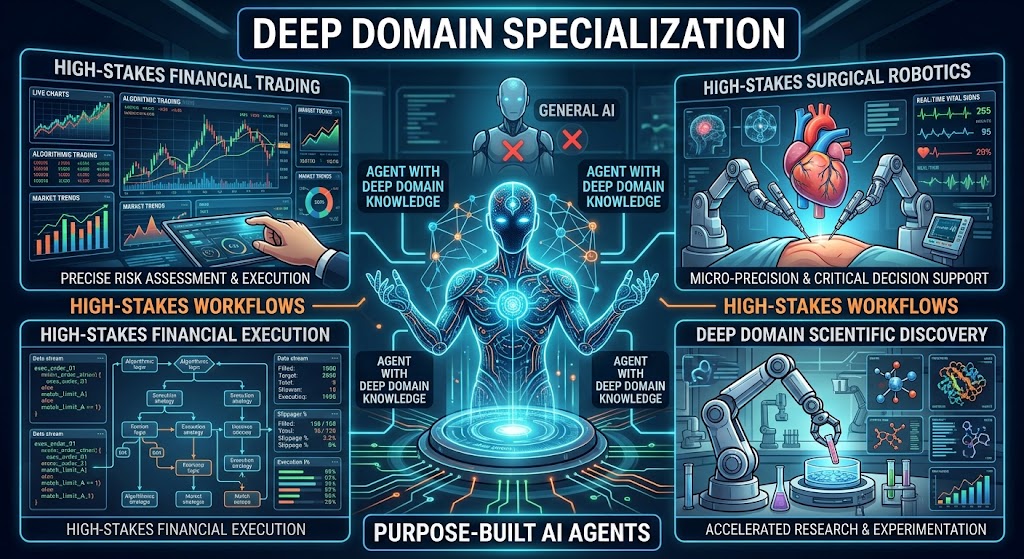
During the first wave of generative AI adoption, enterprise organizations focused primarily on generalist foundation models – which have broad language understanding and can engage in free-form writing and conversations. Yet, in regulated industries, large language models that lack precision, proper terminology, and logical rigidity often hallucinate, leading to erroneous output.
Specialized agents working in a particular domain have demonstrated superior performance over general-purpose AI, particularly in highly regulated industries. Organizations now recognize that the best path to maximizing ROI from enterprise AI is found in developing specialized agential assistants that utilize domain-specific knowledge graphs, data sets, and software tools.
The Case for Specialization in Enterprise AI
To achieve the level of proficiency needed to perform a specialized function, AI agents must be trained using use-case specific knowledge graphs, data sets, and tools. In addition to traditional prompt engineering, creating specialized agents requires continued pre-training on domain-specific literature and direct preference optimization (DPO) with human experts who have extensive experience performing the same tasks as the AI agent.
Another critical element in training specialized AI agents is retrieval augmented generation (RAG) via knowledge graphs. By tying an AI agent to a knowledge graph, you provide it with a comprehensive set of trusted information sources that allow it to reason more accurately and deterministically.
Finally, specialized agents require the use of customized tool adapters that allow them to interact with the specific tools required to perform their tasks. In addition to large language models (LLMs), healthcare-specific AI agents must be able to access tools like Epic or Cerner.
High-stakes Use Cases for Specialized Agents
In the public sector, specialized autonomous agents have been developed to assist in the high-stakes, time-consuming process of tax court case creation and reconciliation. Tax court cases require a complex understanding of the tax code, administrative law, and court procedures. Specialized autonomous agents were able to reduce the time required to create and prepare a tax court case from ten (10) business days to just 30 minutes while increasing classification accuracy. This resulted in tens of thousands of minutes saved per year for one public sector organization.
In the healthcare industry, healthcare providers have deployed specialized documentation assistants to help medical professionals with the time-consuming work of creating clinical documentation. Designed to understand medical concepts, healthcare-specific AI agents have seen high adoption rates among physicians while reducing total documentation time by over 40% and saving each doctor over an hour per day. This has allowed medical professionals to spend more time caring for patients and less time on administrative tasks. Similar opportunities for automation exist for enterprises looking to develop AI documentation assistants or other AI agents working in regulated industries. Healthcare-related AI agents often require specialized training data, such as medical terminology and ICD-10-CM diagnostic codes.
Governance of Specialized Agents in Zero-tolerance Domains
When it comes to deploying AI agents in zero-tolerance domains, organizations must be especially careful to follow all legal and regulatory guidelines. One way to ensure compliance is to impose zero hallucination guardrails on specialized AI agents working in these industries. These hallucination safeguards might include human-in-the-loop (HITL) approval for certain high-risk actions, double-checking steps that rely on primary sources, and maintaining append-only audit trails for all actions taken by an AI agent.
When it comes to foundation models, the race to produce the biggest and best LLMs will ultimately lead to commoditization. Yet, the true value of enterprise AI will be found in the development of specialized agents working in a particular domain. Organizations must invest in a combination of proprietary data, knowledge graphs, and human expertise to train, optimize, and govern specialized agential assistants. By utilizing enterprise MaaS platforms, companies can ensure their specialized AI agents are secure, compliant, and ready to deliver results.
Contributed by GuestPosts.biz
Further Reading: Cyber Gear Thought Leadership Series







Comments are closed.