
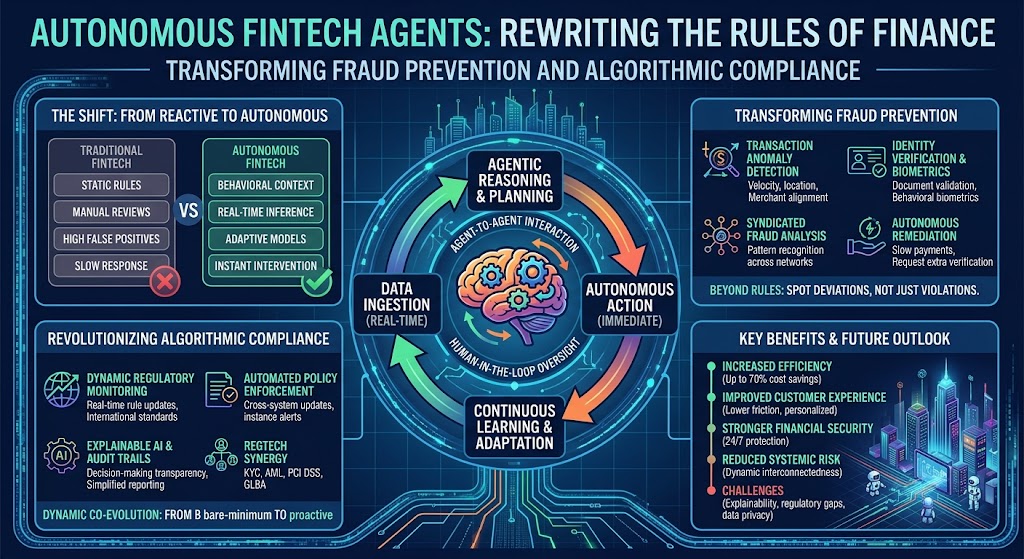
The financial services industry operates in an environment of accelerated transaction volumes, rigorous regulatory oversight, and evolving fraud tactics. Modern financial institutions process multiple digital transactions globally every day, across payment gateways, trading desks, and international settlement channels. This necessitates stringent risk management practices including outsized compliance personnel, manual audit queues, and legacy fraud detection software.
But traditional rule-based fraud detection systems are becoming less viable in the face of modern organized fraud. Rule-based systems employ logical thresholds (transactions over $10,000 or purchases from an unexpected geographic location) to flag or block fraudulent payments. Fraud rings circumvent these simple rules while honest customers are often blocked in the process of catching dishonest actors.
To combat these challenges, financial institutions worldwide are beginning to adopt Autonomous Fintech Agents to modernize financial operations, enhance risk management capabilities, and strengthen regulatory compliance frameworks.
How Financial Agents Operate Within Transaction Pipelines
Fintech agents represent the next evolution in fraud detection beyond simple statistical analysis. By incorporating domain knowledge graphs, continuous telemetry processing, and dynamic goal planning, autonomous financial agents perform as continuous digital risk analysts within transaction pipelines.
Notable capabilities which distinguish autonomous fintech agents from traditional fraud detection models include:
• Multi-vector fraud detection: Beyond simple statistical analysis, financial agents analyze live transactional data across user device fingerprints, historical purchasing patterns, and global threat databases to score and assess risk in real-time
• Autonomous containment procedures: When high-confidence fraud vectors are identified, autonomous agents can initiate containment responses such as card freezes, token revocations, and biometric authentication re-validations
• Contextual exception resolution: In cases where false-positives are identified, fintech agents can analyze additional contextual information to confirm genuine user intent and avoid disrupting legitimate transactions
• Automated regulatory reporting: Throughout the transaction lifecycle, fintech agents can monitor regulatory requirements and autonomously generate audit trail documentation and suspicious activity reports (SAR) for compliance officers
Streamlining Financial Reconciliation & Trade Finance
Beyond direct fraud use cases, autonomous financial agents can help streamline complex financial reconciliation and trade finance operations for financial institutions. Consider the case of cross-border commercial trade finance. To facilitate international letters of credit, trade finance officers must review contracts, shipping manifests, and customs documentation against international sanction lists in relevant currencies.
With an agentic financial architecture, automated compliance agents can help accelerate this process. A specialized sanction-checking agent would review counterparty information against relevant regulatory lists. A currency agent would analyze fluctuating forex rates, while an operational agent would enact appropriate journal entries across core banking systems. This reduces days’ worth of trade finance processing into minutes. Financial enterprises interested in automating their trade finance operations can work with custom AI agent developers to establish compliant, audit-ready operational playbooks.
Governance, Explainability, & Financial Risk Safeguards
Given the sensitive nature of financial operations, the governance and risk management practices around autonomous software agents must be particularly rigorous. Financial regulators globally are mandating strong explainability around AI-driven financial decisions, requiring firms to be able to justify approvals or rejections of particular financial transactions.
To satisfy these requirements, fintech agents must operate in a deterministic policy framework where actions taken by the system can be audited and explained. Decision engines should implement append-only audit trails capturing the rationale and supporting evidence for all automated procedures. For high-value financial operations, mandatory compliance reviews by human operators should be required prior to execution. By implementing comprehensive governance frameworks with enterprise AI Agent platforms, financial firms can satisfy regulatory requirements around automated financial processing.
As financial transactions become increasingly digitalized, firms which implement autonomous fintech agents will see dramatically enhanced financial operations and risk management capabilities.
Contributed by GuestPosts.biz
Further Reading: Cyber Gear Thought Leadership Series







No comments yet.