
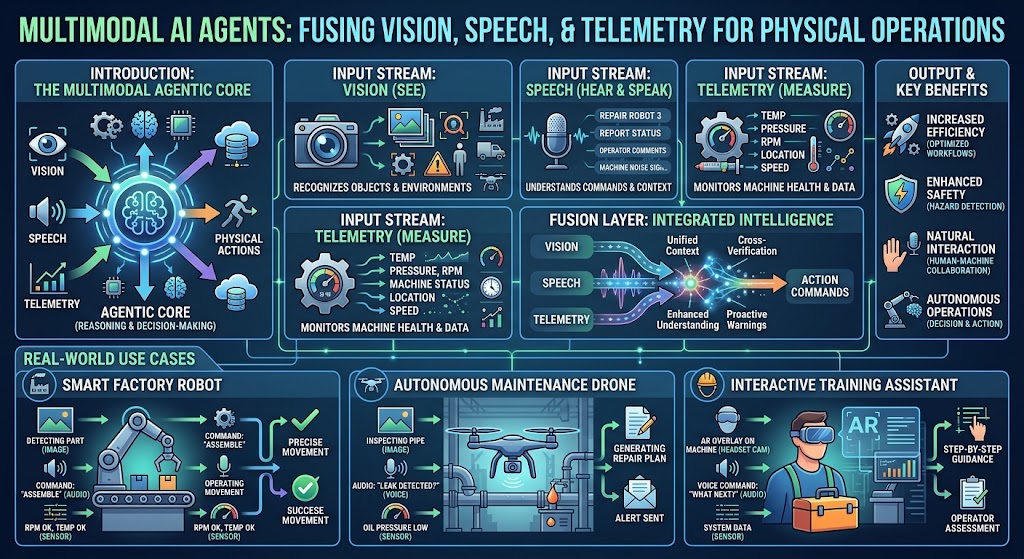
For the early years of corporate adoption, business software primarily communicated with the outside world through text. Early language models read text documents, wrote textual summaries, and responded to typed queries. While text-based processing created significant productivity gains for administrative office work, enterprises have significant operations that exist in the physical world where the working data consists of video feeds, visual inspections, speech, thermal imagery, and sensors.
There is no need to ask for text prompts from field workers or site engineers who are assessing a physical location as part of their daily operations. With the introduction of Multimodal AI Agents, software systems can now observe and reason about the physical world.
The Architecture of Multimodal Agentic Systems
Multimodal AI Agents are an architectural innovation that enable software systems to reason across different modes of input and output. Instead of feeding visual material from a camera to a computer vision model and then translating its conclusions into text for a language model, multimodal agents make both models share a common set of neural weights that natively process various types of sensory information.
Multimodal agentic systems perform continuous physical perception loops, for instance:
• Agents analyze camera feeds and drone videos to identify structural safety issues
• Field technicians speak to a multimodal agent that guides them through physical inspections hands-free
• Visual information from the environment is fused with temperature and acoustics telemetry
• Agents control the physical environment through actuators and update enterprise management software
Transforming Warehouse Logistics and Quality Control
The business impact of multimodal agents is currently being seen in applications relating to operations management. Computer vision agents are being used to inspect goods in retail logistics and construction worksites. In a traditional electronics manufacturing plant, quality control involves visual human inspection of circuit boards on a high-speed conveyor belt. This requires workers to perform delicate visual tasks for extended periods of time and increases the risk of worker injury.
In a manufacturing plant utilizing multimodal agents, high-speed vision inspection cameras relay visual information to inspection agents. These agents identify soldering fractures and assess the visual quality of electronic components. They also analyze the thermal telemetry from the camera and confirm that there are no internal heating irregularities. When manufacturing defects are identified, the multimodal agent relays instructions to high-speed robotic arms that remove the faulty circuits from the conveyor belt. It also updates the supply chain management database and advises the assembly line foreman by voice. Companies that wish to inspect physical goods in their supply chains can begin by requesting a custom AI agent development service that equips their conveyor belts with real-time visual inspection AI models.
Safety, Latency, and Privacy in Physical Operations
The use of multimodal AI agents in physical environments raises important safety and latency considerations. In enterprise software applications, the worst-case scenario of an incorrectly behaving agent would involve canceling a scheduled meeting or replying to an email with the wrong message. In physical environments, an incorrectly behaving multimodal agent might operate industrial cranes and cause damage to the physical environment.
To guarantee the safety of people and property, multimodal agents have to employ hardware-level safety overrides for high-impact operations. Voice, video, and other physical interfaces to the agents should implement automated blur of identifiable elements such as faces and license plates. Companies can begin building these safety guarantees with enterprise AI Agent platforms that provide safety-critical physical operations.
Contributed by GuestPosts.biz
Further Reading: Cyber Gear Thought Leadership Series







No comments yet.