
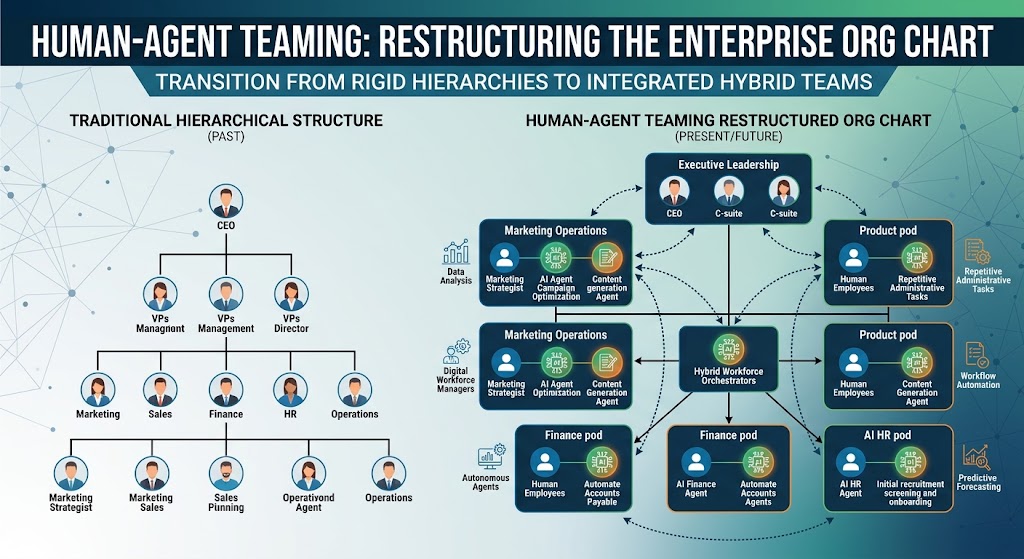
The deployment of autonomous multi-agent networks requires a fundamental restructuring of enterprise organizational design. Previously, executives assessed software utility based on workforce productivity gains at an individual contributor level, asking how much faster could an employee perform a specific task with the aid of particular software, for example, how much faster could a worker write an email, analyze a spreadsheet, or write a script.
Autonomous agent networks render this metric largely obsolete. Most executive leaderships understand that autonomous agentic architectures will disrupt business processes far deeper than the advent of the internet, necessitating a fundamental redesign around what the author terms the Human-Agent Workforce. In this new paradigm, independent software agents comprise a digital workforce executing discrete processes, engaging in middleware coordination, and handling routine decision making, while humans supervise, direct, and evaluate the overall agency network in terms of policy, ethical risk, and handling of exceptional cases.
The Three Phases of Workforce Restructuring
With the shift towards autonomous software engineering, enterprise staffing approaches are being restructured in three broad areas:
Targeted Reductions in Headcount: Workforces engaged in large-scale low–complexity data processing roles are being reorganized, particularly within first–line customer care and operations staff.
Restructuring with Reskilling: The roles of enterprise staff are being redefined at an individual contributor level, as human workers are upskilled to oversee, configure, and audit the autonomous agent processes that handle rote operations, shifting human effort towards higher value customer interactions, creative problem-solving, and growth-oriented activities.
Expansion of Overall Capacity: Growth–focused technology organizations are capitalizing on the increased processing capability to expand their footprint in new geographic markets, product categories, and modalities, while also generating new specialty jobs within the enterprise focused on agent orchestration and auditing.
Redesign of Functional Organization
Human-agent workforce organizations are likely to see fundamental changes to core functional groups such as in Customer Experience (CX), Finance, and Sales. Autonomous agent networks are capable of handling the majority of first– and second-tier customer support interactions, enabling human CX agents to focus their effort on the most complex, high value, and emotionally charged support cases.
Similarly, financial agents can be deployed to handle bookkeeping, invoicing, and inter–module accounting coordination, while human financial analysts focus on complex capital allocation, audit control, and treasury management. In the B2B selling function, autonomous agents can be utilized to augment the lead qualification, account research, and RFP response processes, while human sellers focus on high-level relationship selling and deal closure.
Workforce Trust and Friction Management
While the shift to human-agent workforce design has enormous productivity advantages, it also poses serious challenges for workforce management at multiple levels. One key area involves the development of appropriate levels of trust in autonomous processing, which tends to be challenging for many non-executive employees. While many first-line managers, senior leaders, and C-level executives express high levels of confidence in the potential of independent software agents, many other workers are less enthusiastic about delegating core business processes to unpredictable algorithms.
This dynamic can slow down the adoption of autonomous agent processes, as workers may attempt to bypass the recommended digital workflows in favor of manual processing. Effective human-agent organizational design requires the development of appropriate human-in-the-loop (HITL) governance points, as well as the utilization of predictive analytics and middleware proxy tools to ensure standardized and transparent processing. Effective workforce governance utilizing enterprise-level AI agent frameworks will be critical in ensuring predictable results.
Agentic Capability Will Become the New Productivity Metric
Over the next few years, business analysts will begin to evaluate enterprise performance based on agentic capability scores, which will indicate an organization’s potential to scale its business processes exponentially via autonomous agents and hybrid human-agent workflows. Organizations that begin to develop effective human-agent collaboration frameworks now will gain enormous competitive advantage over the medium term horizon.
Contributed by GuestPosts.biz
Further Reading: Cyber Gear Thought Leadership Series







Comments are closed.