
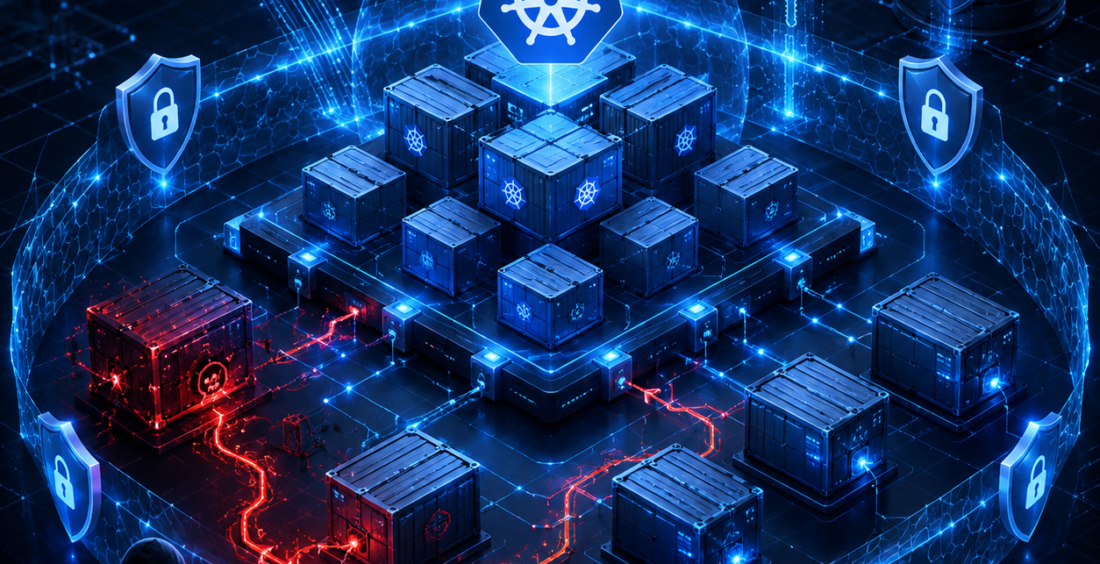
Kubernetes security is becoming a bigger cybersecurity concern as companies run more applications, APIs and AI workloads inside containers.
Kubernetes helps teams deploy and manage those containers at scale. That flexibility is useful, but it also creates a powerful control layer. A cluster may contain production applications, credentials, service accounts and access to cloud resources.
If an attacker gains the wrong permissions inside that environment, a small foothold can become a much larger problem.
Why Kubernetes Attracts Attackers
Kubernetes sits close to applications and the infrastructure that runs them.
A compromised cluster can give an attacker access to workloads, configuration data, secrets or internal services. In badly configured environments, it may also provide a path toward cloud resources outside the cluster.
Google Cloud’s 2026 threat guidance warns that attackers who gain a foothold in Kubernetes can abuse over-permissive role-based access controls to delete deployments, wipe persistent volumes or disrupt important workloads.
That is a lot of power from one control plane.
Service Accounts Can Become Hidden Privileged Users
Kubernetes workloads often use service accounts to communicate with the cluster API.
These are machine identities rather than employee accounts. A service account might allow an application to read configuration, access a resource or perform an automated task.
The danger appears when those identities receive more permission than they need.
Kubernetes documentation recommends using role-based access control, or RBAC, to give service accounts only the minimum permissions required.
A stolen service-account token with broad privileges can give an attacker trusted access without compromising a human administrator.
Least Privilege Matters Inside the Cluster
Convenience can lead teams to grant broad permissions during development.
A workload is given administrator rights because it fixes an error. A wildcard permission is added because nobody wants a deployment to fail. Months later, those permissions remain.
The official Kubernetes RBAC guidance recommends least privilege and warns that wildcard permissions can unintentionally grant access to sensitive resources.
Permissions should match the workload’s actual job.
A reporting service that reads data does not need the ability to delete deployments. A monitoring tool should not automatically control every secret in the cluster.
Exposed Management Interfaces Create Easy Paths
A secure cluster can still become vulnerable if its management interfaces are exposed carelessly.
Administrative dashboards, APIs and development tools should not be reachable from the public internet unless there is a strong reason and suitable protection.
Attackers continuously scan for exposed infrastructure. Google’s Cloud Threat Horizons H1 2026 notes that threat actors gained access through misconfigured infrastructure and inadequately secured API endpoints in observed cloud incidents.
Visibility matters because teams cannot secure an interface they do not realize is public.
Containers Need Boundaries Too
Containers are designed to isolate applications, but that isolation depends on configuration.
A container running with excessive privileges may have more access to the underlying system than its application requires. Kubernetes provides security-context controls that can limit privileges, file-system access and how containers run.
The Kubernetes security-context guidance encourages teams to define these controls rather than accepting powerful defaults.
The goal is simple: if one container is compromised, the attacker should not automatically inherit control over the host or neighboring workloads.
Secrets Should Not Be Easy to Reach
Clusters often need database passwords, API keys and cloud credentials.
Those secrets are valuable because they can open doors beyond Kubernetes itself.
Organizations should limit which workloads can access them, rotate exposed credentials and avoid placing sensitive values where every container can read them.
Short-lived identities and workload-based authentication can also reduce dependence on long-lasting static credentials.
A secret used by one application should not become a master key for the whole environment.
Kubernetes Security Needs Continuous Visibility
Clusters change quickly. New workloads appear, containers are replaced and permissions change as teams release software.
A security review performed once a year will miss that movement.
Organizations need visibility into which workloads are running, which identities they use, what permissions they hold and whether unusual behavior appears.
Google Cloud’s Container Threat Detection includes detections for Kubernetes-specific attack tools, showing why runtime activity matters alongside configuration reviews.
Regular testing can reveal gaps before attackers do. Teams should review RBAC changes, scan container images, test incident response and confirm that logs remain available during a compromise. Security ownership should also be clear. Developers, platform engineers and security teams all influence Kubernetes risk, so protecting the cluster works best when responsibility is shared rather than assumed.
The key question is not simply, “Is our cluster running?”
It is, “If one workload or service account were compromised today, how far could an attacker go?”
That question turns Kubernetes from an infrastructure topic into what it really is: an important part of modern cybersecurity.
Contributed by GuestPosts.biz
Further Reading: Cyber Gear Thought Leadership Series







Comments are closed.