
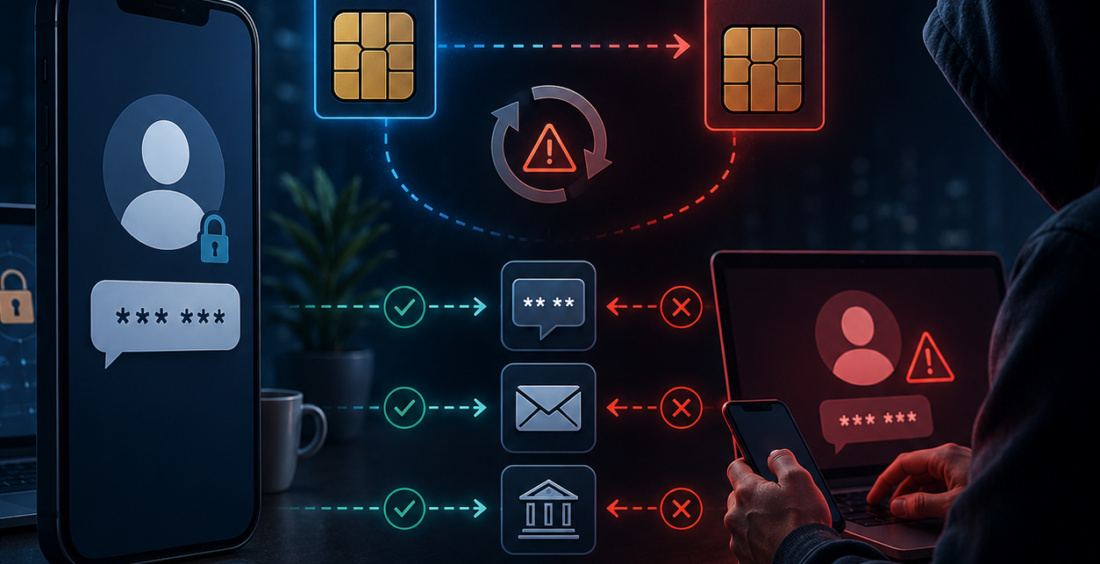
SIM swapping is a cybersecurity threat that turns a phone number into a way around security. Instead of stealing the phone, an attacker convinces a carrier to move the victim’s number to another SIM.
Once the transfer succeeds, calls and text messages meant for the real owner can reach the attacker instead.
Many services still use SMS codes for password resets and multi-factor authentication. Control of a phone number can therefore become a shortcut into email, financial accounts and business systems.
Why SIM Swapping Still Works
Phone numbers have become part of digital identity.
Banks, cloud services and consumer platforms may use them to verify a user, send security alerts or deliver one-time codes. Attackers understand that relationship.
A criminal may collect information from phishing, social media or data breaches, then contact a carrier while pretending to be the victim. If the request is accepted, the number can move to an attacker-controlled SIM.
The FCC has adopted rules requiring wireless providers to use stronger authentication before certain SIM changes and number transfers.
The Phone May Suddenly Go Silent
One warning sign is surprisingly ordinary: the victim’s phone suddenly loses cellular service.
Calls stop arriving. Text messages fail. Mobile data may disappear although the device itself seems fine.
That can happen for harmless reasons, but unexpected loss of service deserves attention, especially if account alerts or password-reset messages appeared beforehand.
The FTC advises people who suspect a SIM swap to contact their mobile provider immediately and regain control of the number.
Employees should also know whom to contact internally if the affected phone is used for work authentication.
SMS MFA Has a Weak Link
Multi-factor authentication is still important, but not every form of MFA offers the same protection.
SMS verification depends partly on control of the phone number. If that number is transferred to an attacker, security codes may follow it.
The FTC recommends stronger authentication methods for sensitive accounts and notes that authenticator apps or security keys are not vulnerable to SIM swapping in the same way as text-message codes.
CISA also encourages organizations to move toward phishing-resistant MFA wherever possible.
The goal is not to turn off MFA. Use stronger forms when the account matters.
Email Can Become the Next Target
A stolen phone number becomes more dangerous when it is tied to an important email account.
Email often acts as the recovery center for other services. An attacker who takes over the inbox may request password resets, read security notifications and discover which platforms the victim uses.
One compromised number can lead to several compromised accounts.
Businesses should protect email with strong authentication that does not depend only on SMS. They should also review account recovery settings and remove outdated phone numbers or weak fallback methods that make stronger controls easier to bypass.
Carrier Accounts Need Security Too
People often protect banking and email accounts carefully while giving less attention to the mobile carrier account behind their phone number.
That account deserves protection.
Users should set a carrier PIN or other account protections where available and be cautious about sharing personal details that could help someone impersonate them.
The FCC’s SIM-swap rules require providers to notify customers about SIM changes and number-transfer requests, giving people another chance to spot unauthorized activity.
Organizations can also encourage employees with privileged access to review the protections attached to their work phone numbers.
Recovery Should Include More Than the SIM
Getting the phone number back is only the beginning after a successful swap.
The attacker may already have reset passwords, created sessions or changed recovery information.
Victims should review important accounts, change compromised credentials, sign out of unfamiliar sessions and check for security settings they did not create. Financial accounts also deserve immediate review for unauthorized activity.
For company accounts, security teams should investigate what happened while the attacker controlled the number.
A recovered SIM does not invalidate access that was already stolen.
Move Beyond the Phone Number
SIM swapping is a reminder that a phone number was designed for communication, not as a perfect digital identity.
It can still be useful for alerts and lower-risk verification, but sensitive accounts should not depend on it as the strongest proof of identity.
Businesses can reduce exposure by adopting phishing-resistant authentication, strengthening account recovery and monitoring unusual identity changes.
Employees should also recognize sudden loss of cellular service as a possible security signal rather than only a technical inconvenience.
The question is not simply, “Do we use MFA?”
It is, “What happens if someone else takes control of the phone number behind it?”
Answering that question can reveal whether a convenient authentication method has quietly become a cybersecurity weak point.
Contributed by GuestPosts.biz
Further Reading: Cyber Gear Thought Leadership Series







Comments are closed.