
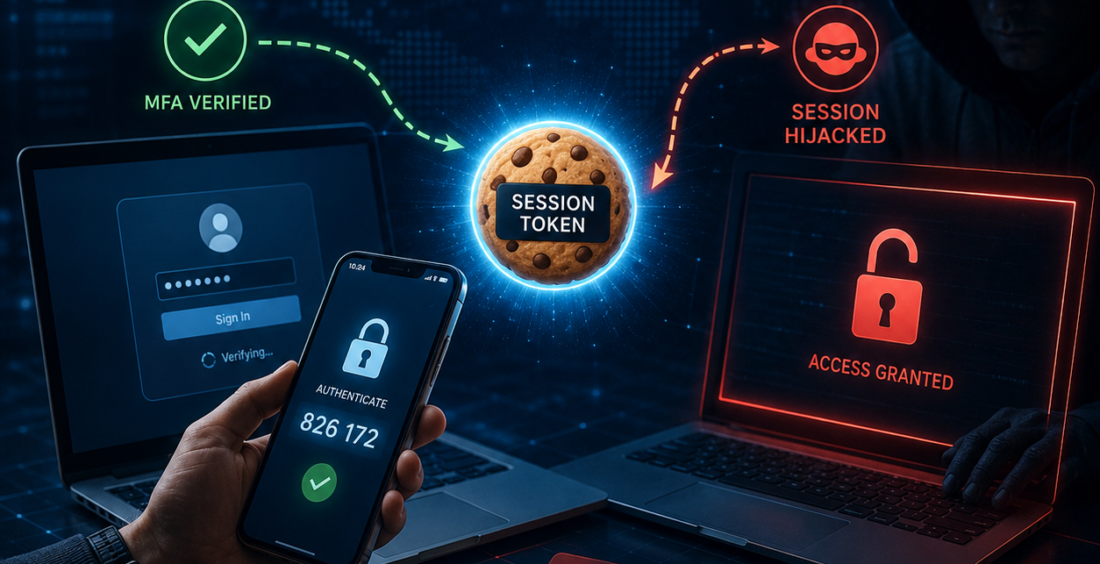
Multi-factor authentication is standard cybersecurity advice. Use a password, confirm your identity another way, and an attacker has a harder time getting into your account.
That advice matters. But attackers adapted.
Instead of stealing only passwords, some criminals target the digital proof that tells a website you have logged in. This proof is often stored in a session cookie or authentication token. If an attacker steals it, they may enter an account without repeating the usual authentication process.
That is why session hijacking matters in 2026.
What Is a Session Token?
Think about signing in to an online service. You enter your credentials, complete multi-factor authentication, and continue without proving who you are on every page.
The system remembers that you have already signed in.
It does this using a session cookie or token. In simple terms, the token acts like a temporary digital pass. As long as that pass remains valid, the service recognizes the user and allows the session to continue.
This makes online services practical. Nobody wants to approve authentication every time they open an email.
The problem begins when someone else gets that pass.
How Attackers Steal an Active Session
One method is adversary-in-the-middle phishing. Instead of a simple fake login page, the attacker places a malicious service between the victim and real website.
The victim may see a normal login experience. They enter their password and complete MFA. The attacker captures the resulting authentication token and can attempt to reuse it.
Microsoft documented multiple campaigns in 2026 using this technique, including attacks designed to capture session cookies and gain access after the victim successfully completed authentication.
Malware can create the same problem. Information-stealing malware may collect browser data, credentials, cookies, and other information that can help attackers take over online accounts.
MFA Still Matters
It would be a mistake to conclude that MFA no longer works.
MFA blocks many common account attacks and remains an essential layer of protection. The issue is that not every form of MFA offers the same protection against modern phishing techniques.
Traditional one-time codes, push notifications, and similar methods can still be exposed when an attacker successfully places themselves inside the authentication process.
Phishing-resistant methods, including approaches based on FIDO security standards, are designed to make that type of interception much harder. CISA has repeatedly encouraged organizations to adopt phishing-resistant MFA for accounts that need stronger protection.
Security cannot stop at the login screen.
Protect the Session, Not Just the Password
Companies have spent years strengthening passwords and login procedures. Now they also need to think about what happens after authentication succeeds.
That means paying attention to session behavior.
A login from one location followed shortly by unusual activity from another location could be suspicious. So could a session suddenly accessing information or services that the user rarely touches.
Organizations can also reduce risk by limiting how long sensitive sessions remain valid, protecting tokens so they are harder to replay on another device, and revoking active sessions when an account is suspected of being compromised.
Microsoft, for example, has introduced token protection controls intended to reduce replay attacks by tying supported sign-in sessions more closely to the device being used.
Employees Need a Different Phishing Message
Security awareness also needs to evolve.
For years, employees have been told not to give away their passwords. That is still good advice, but a convincing phishing attack may no longer need the victim to hand a password directly to an attacker.
A person can enter the correct password on what looks like a legitimate sign-in process, approve MFA, and still end up exposing the session.
Training should therefore focus less on memorizing warning signs and more on healthy habits. Employees should be cautious with unexpected login requests, links that lead to authentication pages, and urgent messages asking them to sign in to view a document.
A successful MFA prompt should not automatically make a situation feel safe.
Identity Security Is Becoming Continuous
The larger lesson is simple: authentication is no longer a single moment.
Organizations cannot assume that once a user successfully signs in, everything that follows is trustworthy. Identity needs to be checked throughout the session using context such as the device, location, behavior, and sensitivity of the action being performed.
Passwords are still important. MFA is still important. But modern identity security increasingly depends on protecting what happens after both have done their job.
The question is no longer just, “Did the right person log in?”
It is also, “Is the right person still behind this session?”
That small change in thinking can make a big difference as attackers shift their attention from stealing credentials to stealing access itself.
Contributed by GuestPosts.biz
Further Reading: Cyber Gear Thought Leadership Series







Comments are closed.