
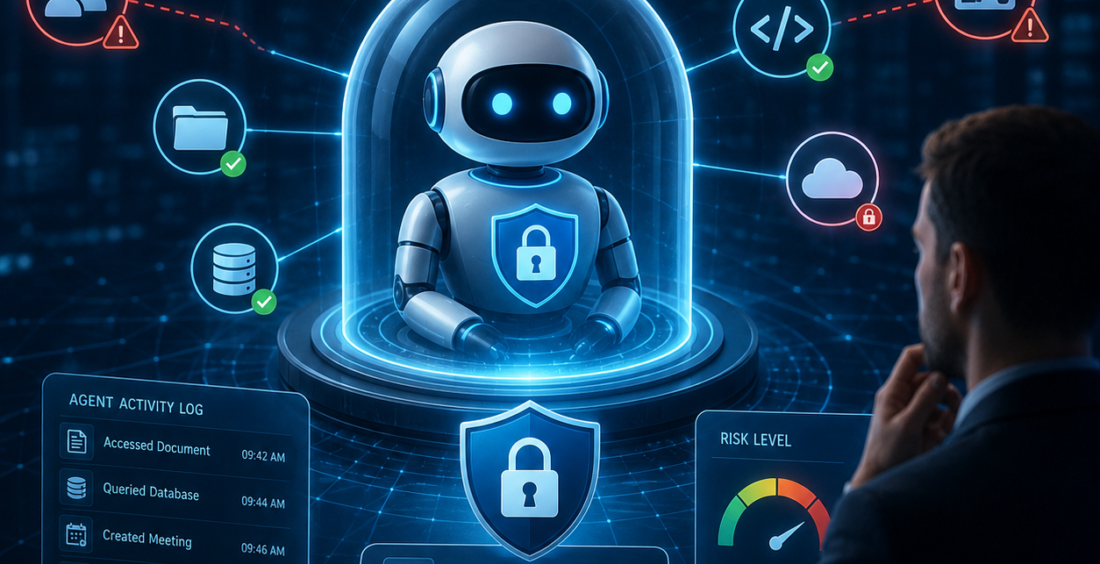
When AI Agents Get Too Much Access: The Hidden Security Risk of Autonomous AI
AI assistants traditionally responded to prompts and waited for the user’s next instruction. Agentic AI changes that. Today, an AI agent can be given a goal, plan the steps, connect to tools and take action on a user’s behalf.
That can be useful. An agent might update customer records, schedule meetings or prepare a payment. But the more it can do, the more important one question becomes: how much access should it really have?
This is becoming a major security concern. The risk appears when agents receive broad permissions without enough limits, monitoring or human oversight. If an agent makes a poor decision or follows a malicious instruction, a small mistake can become a serious incident.
Why Access Matters More With AI Agents
Traditional software usually has a narrow job. Payroll systems handle payroll, while customer platforms manage customer records. Security teams can generally predict what they should access.
AI agents are more flexible. They may decide how to complete a task, choose which tool to use and move between systems without a person approving every step.
Imagine an AI agent that can read documents, check calendars and send emails. If it opens a document containing hidden instructions to forward sensitive information, an attacker may only need to trick the agent into acting for them.
Security teams must consider both sides.
Give Agents Only the Access They Need
Cybersecurity has long followed a principle called “least privilege.” It means giving people and systems only the access they need to do their jobs. The same rule should apply to AI agents.
A scheduling assistant may need to view a calendar and create meetings. It probably does not need payroll data or access to a company’s entire document library. A coding agent may need a specific repository, but it should not automatically be allowed to push changes into a live production environment.
Broad access feels convenient, but if something goes wrong, the potential damage becomes much larger.
An AI Agent Should Have Its Own Identity
Some organizations allow AI agents to use an employee’s account or credentials. This is easy to set up, but creates confusion. If something unusual happens, it becomes harder to tell whether the employee or AI took the action.
A better approach is to give the agent its own identifiable account or digital identity. Security teams can then control its permissions, monitor its activity and remove access without affecting the human user.
This also makes investigations easier. If an unexpected file transfer occurs, the organization can see whether it came from a person, an application or an AI agent.
Not Every Action Should Be Automatic
There is a big difference between allowing an agent to prepare something and allowing it to complete the action.
Drafting an email generally carries less risk than sending it automatically to thousands of customers. An agent could prepare a payment request, but transferring money may need human approval. It might suggest a software update, while deployment to a critical system should require review.
The goal is not to require approval for every task. That would remove much of the value of automation. Instead, organizations should identify actions that could cause serious financial, operational or security damage and add safeguards around them.
The higher the impact, the stronger the control should be.
Treat Powerful Agents Like Privileged Users
Companies already pay special attention to administrator accounts because they can reach sensitive systems. Powerful AI agents should be treated in much the same way.
Organizations should know which agents are active, who is responsible for them, what systems they can access and what actions they can take. Permissions should be reviewed regularly so temporary agents do not keep permanent access.
Monitoring matters too. AI agents can take several actions quickly. If something goes wrong, security teams need a clear record of what happened. Good logs should show what the agent accessed, which tool it used and what action it took.
The Goal Is Controlled Autonomy
Agentic AI will continue to become more capable, and businesses will find new ways to use it. Trying to remove all autonomy is not realistic. The better approach is controlled autonomy.
AI agents should have a clear identity, limited permissions, sensible boundaries around high-risk actions and enough monitoring to understand what they are doing.
For any organization deploying agentic AI, one practical question can reveal a lot:
If this agent made the wrong decision right now, what could it actually do?
If the answer is “not much,” the organization is probably on the right track. If the answer is “almost anything,” the real problem may be the amount of power the organization has handed over.
Contributed by GuestPosts.biz
Further Reading: Cyber Gear Thought Leadership Series







Comments are closed.