
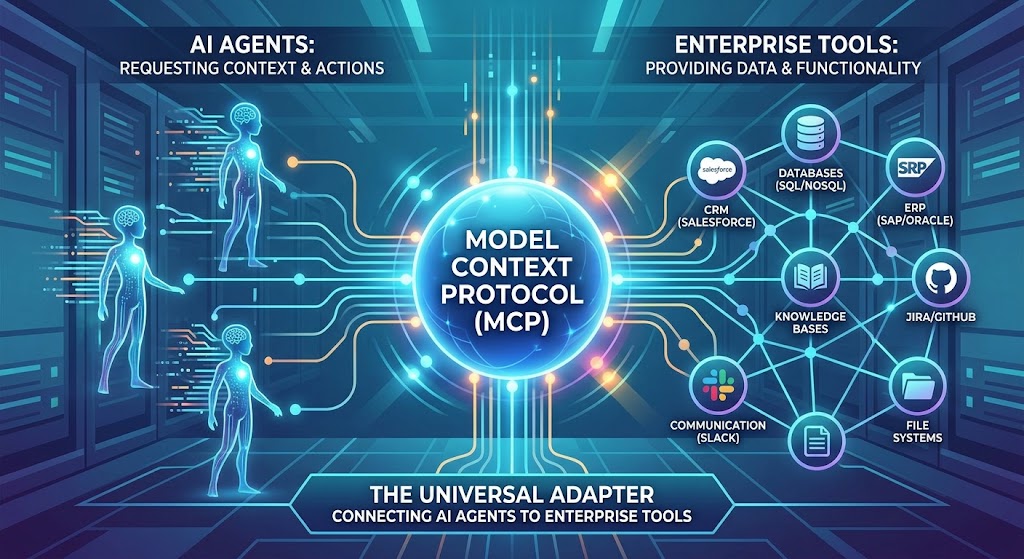
For an autonomous AI agent to be genuinely useful, it has to be able to access the business data required to perform its tasks. This means querying relational databases, reading from local code repositories, accessing SaaS applications over the cloud, and writing the results back to the appropriate systems. Previously, building connections between a language model runtime and external tools required writing wrappers for every single model-tool combination. If a company was using 5 different model environments and 20 different software tools, that creates a complex matrix of potential connections, any of which could be made more difficult by database schema or model parameter mismatches.
This burden is being dramatically reduced through the use of the Model Context Protocol, or MCP. This standard is being adopted by the industry to provide a universal connection layer for AI agents in much the same way that the Language Server Protocol (LSP) has standardized the way code editors communicate with programming languages.
The Host-Client-Server Architecture of MCP
At a technical level, MCP defines a simple Host-Client-Server architecture. An MCP Host is a process that provides the environment for agent execution. The Host contains an MCP Client, which is responsible for maintaining the connection to one or more MCP Servers. Each server is usually associated with a particular data source, such as a database or file system, or a particular set of tools. The client and server communicate over a secure channel, which allows the agent to access data and execute functions.
The protocol defines 4 primary execution primitives:
Resources
Tools
Prompts
Sampling
Resources are streams of data made available to the agent, usually as the result of a database query or other similar request. They can be read-only or read-write and are usually identified by a URI.
Tools are functions that accept parameters from the agent and perform an action, such as writing to a database or executing an external webhook.
Prompts are templates provided by the server that instruct the model on how to handle specific data formats.
Sampling is a special execution primitive that allows an MCP server to request additional model outputs nested within the main response. This allows the agent to perform complex operations while maintaining control over the process.
Reducing Latency and Token Costs with Local Compute Sandboxing
One of the most exciting applications of the new context layer is the ability to offload processing to local compute nodes. Previously, an agent would have to perform any heavy lifting itself or pay for the cost of large model parameters to process the data. For example, an agent trying to filter a large data set would have to send the entire data set through the model, which would incur large costs and cause issues with context length.
With the new standard, an agent can send a small amount of code to a local sandbox for processing, where it will be executed and returned to the agent in a compact form. This dramatically reduces the token costs incurred by the agent while reducing latency and allowing the model to focus on higher-level tasks. At the same time, the data never leaves the local server, which helps keep sensitive information secure.
Securing Tool Connectors Across the Enterprise
While the new standard makes it much easier to connect agents to tools, it is important to remember that exposing executable code to autonomous agents can create security risks. In particular, it is important to make sure that agents are not able to access databases or other systems with overly permissive settings, as this could allow an attacker to inject prompts through specially crafted database entries.
To reduce the risk of unauthorized access, it is important to make sure that tools are only accessible to agents through carefully constructed permissions. Ideally, resources should be read-only by default, and any tools that do not follow this principle should be executed in isolated environments whenever possible. Prompt injection risks can be reduced by implementing inline filters that check for unauthorized content before executing any requests.
As more and more software vendors begin to provide built-in support for MCP servers, the new standard is set to become a ubiquitous part of enterprise software stacks. The companies that embrace this development and begin to standardize their context layers will be the first to unlock the full potential of the emerging agentic workforce.
Contributed by GuestPosts.biz
Further Reading: Cyber Gear Thought Leadership Series







Comments are closed.