
Modern cloud infrastructure has become so complicated that it can overwhelm even the most experienced developers. Microservices, multiple cloud hosting platforms, serverless functions, and orchestration frameworks like Kubernetes create trillions of telemetry events every day. When production incidents occur, Site Reliability Engineering and DevOps teams have to wade through tens of thousands of log messages across different monitoring platforms to troubleshoot problems.
Traditional IT Service Management automation tools only have hard-coded alerting thresholds and basic scripts for incident triage. If a database CPU usage crosses 90%, a predefined script could be triggered to restart the container. But if an unindexed database query is the root cause or a memory leak in an upstream microservice is impacting the targeted application, generic scripts would do nothing to resolve the issue. Human engineers would still need to spend hours on conference bridge calls diagnosing production incidents.
DevOps AI Agents
Engineers around the world are adopting DevOps AI agents to build self-healing cloud infrastructure.
The Role of Self-Healing AI Agents in Cloud Infrastructure
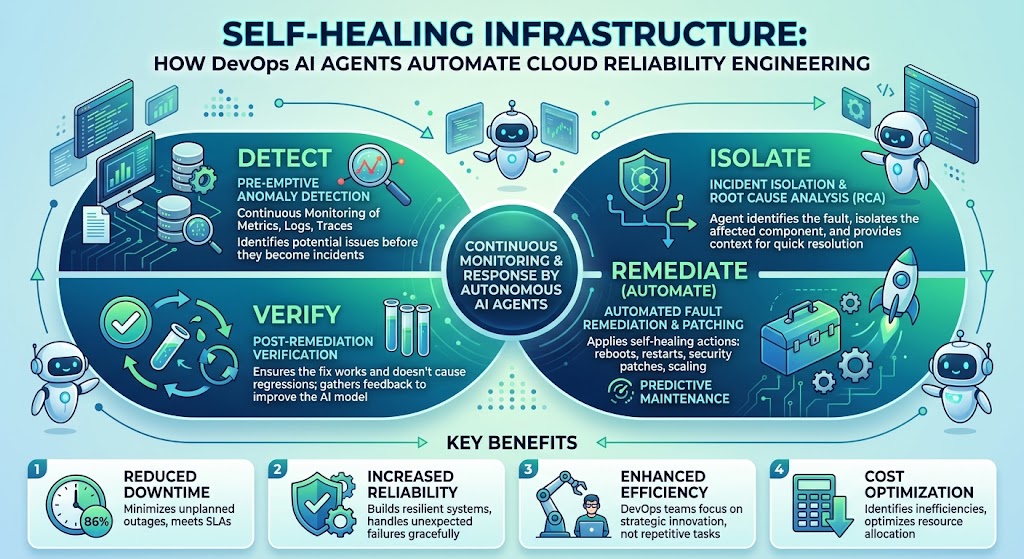
DevOps AI agents act as continuous digital Site Reliability Engineers. These specialized agents are embedded inside cloud infrastructure, CI/CD pipelines, and observability tools to constantly analyze telemetry data, determine root-cause analysis, and perform autonomous remediation steps.
Here are some ways that self-healing infrastructure agents could be used to remediate cloud incidents:
1. Agents constantly analyze log streams and metrics flowing through cloud environments.
2. When an anomaly is detected, the agent uses enterprise knowledge graphs to determine root causes and lateral impacts across hybrid cloud environments.
3. If confidence thresholds are met, the agent could perform autonomous remediation steps like provisioning new infrastructure nodes or rewriting load balancer routing rules. Some agents can even perform complete canary deploys of cloud applications.
4. The agent could generate human-readable post-mortem analysis reports for cloud incidents.
Besides triaging production incidents, DevOps agents can also optimize cloud operations at a macro level. For example, an autonomous agent could be programmed to always keep a certain percentage of available resources in reserve. Or, when security vulnerability reports are released for certain server packages, a DevOps agent could scan through all existing container images to update affected components and run automated testing suites.
The Cost of Self-Healing Cloud Infrastructure
While many technology leaders consider the costs of building self-healing infrastructure to be prohibitive, the long-term gains in developer productivity are substantial.
Guardrails and Circuit Breakers for Self-Healing Infrastructure
The ability for AI agents to make arbitrary code changes to cloud infrastructure could create new opportunities for infrastructure damage. If a rogue agent or unauthorized third-party tool incorrectly concluded that production database clusters needed to be terminated or that enterprise encryption keys needed to be revoked, an entire technology stack could be taken down by a single misconfigured remediation step. Technology executives should implement strict governance and control policies for production infrastructure stewardship. For example, agents should never be permitted to take direct action to delete production storage instances or modify key networking security groups. All such infrastructure changes should be manually audited by human Site Reliability Engineers. Another circuit breaker could be implemented if an agent attempts too many remediation steps within a short timeframe before requiring human intervention. By implementing zero-trust infrastructure stewardship policies, enterprise security teams can reduce the risks of unauthorized production changes.
As cloud infrastructure becomes increasingly complex, organizations will need to embrace self-healing infrastructure to reduce operational expenditures and increase software delivery velocity. Enterprises that adopt self-healing DevOps agents will see dramatic decreases in production downtime while improving the quality of their software delivery processes.
Contributed by GuestPosts.biz
Further Reading: Cyber Gear Thought Leadership Series







No comments yet.