
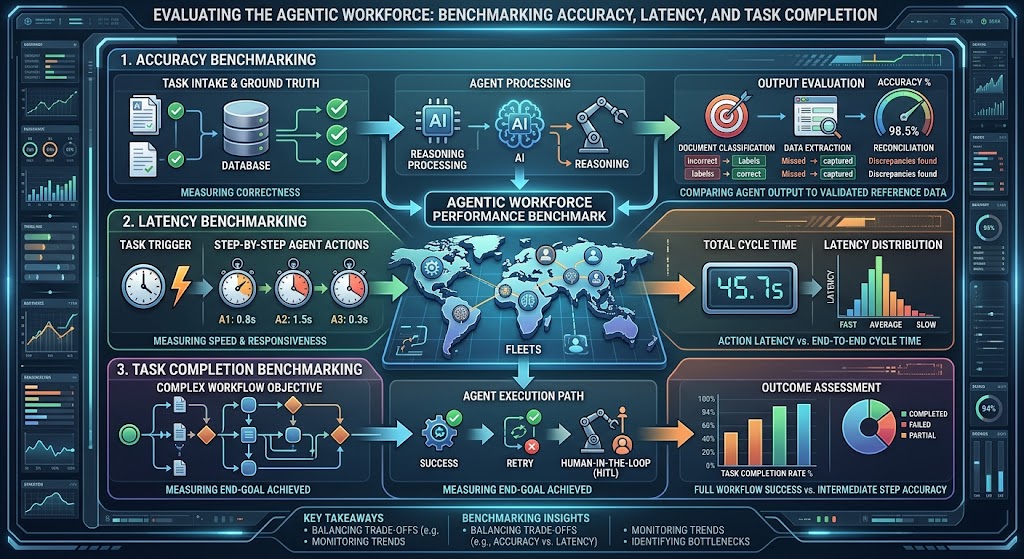
As companies evolve from simple conversational bots, executive management needs to develop new ways to assess, evaluate, and audit autonomous digital workers
Software development traditionally has rudimentary metrics – does the compiled code throw errors or not. Early chatbot development focused on qualitative measures of responses fluency or textual similarity. But when it comes to AI agents that can perform business functions, route enterprise API calls, and modify production ledgers – companies need quantitative frameworks for evaluating multi-step business processes execution, time-performance characteristics, and financial viability.
Core Principles of AI Agent Evaluation
When it comes to assessing the performance of an autonomous workforce, traditional approaches of binary scoring are insufficient. Enterprise software teams usually track four core performance indicators when measuring agent efficacy in executing business processes:
1. Task completion rate (TCR) – the percentage of multi-step processes fully executed by the AI agent without requiring any human inputs or interventions
2. Execution latency – the time required for an AI agent to parse, analyze, and finalize an output for a given business process
3. Token-unit economics – the amount of computational power spent on executing the process versus the automation value gained
4. Trajectory accuracy – the ability of the agent to pick an optimal set of tools and avoid unnecessary processing steps
Sandboxes – Building Synthetic Reality for Testing AI Agents
To evaluate AI performance before exposing it to live production data, enterprise software engineers use sandboxes – isolated testing environments simulating real-world business processes. Within these test chambers, AI agents have to execute thousands of synthetic transactions with malformed input data, faulty API endpoints, and unexpected parameter combinations.
For example, within a sandbox environment for a supply chain procurement agent, the testing software would simulate supplier API endpoints returning random errors, price surcharges, or malformed shipping instructions. The evaluation framework would then analyze the agent’s ability to adapt, recover, and enforce corporate spending policies. Companies looking to build such testing environments can work with AI agent development firms to design bespoke sandbox simulations.
Governance, Regression Auditing, and Budget Constraints
An ongoing evaluation process also serves to ensure that evolving foundation models do not introduce disruptive shifts in agent performance. As large language models underlying AI applications are continually refined and optimized by foundation model suppliers, autonomous agents may exhibit unexpected behaviors. These deviations may manifest as reduced task-completion rates, increased processing time, or inappropriate tool selection.
To govern these risks, enterprise software teams employ automated regression testing mechanisms that constantly audit changes in agent performance. Additionally, continuous evaluation assists in cost governance by analyzing real-time token pricing and usage statistics. If a specific business process stops being economically viable, the evaluation framework automatically flags it for review. By implementing these governance and financial controls, companies can ensure that their AI workforce operates within acceptable parameters of performance and budgets.
The ability to evaluate autonomous agents will become a critical aspect of corporate IT leadership. Enterprises that develop the capabilities to assess, score, and optimize AI performance will be best positioned to benefit from automation while retaining control over digital processes.
Contributed by GuestPosts.biz
Further Reading: Cyber Gear Thought Leadership Series







No comments yet.