
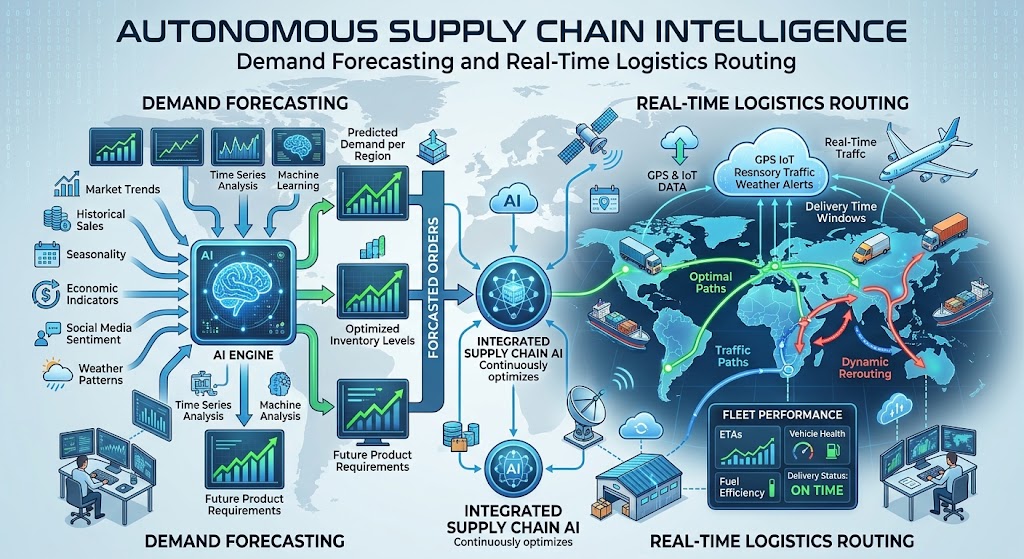
Global supply chains have become extremely complex. Political tensions, regional port congestion, weather patterns, and shifting consumer preferences shape a consistently uncertain environment for international trade. Contemporary supply chains comprise thousands of interlocking elements that need to be constantly monitored, including lead times, customs documentation, carrier costs, and delivery logistics.
Traditional enterprise resource planning and supply chain management software are ill-equipped to handle this level of uncertainty. When confronted with sudden shipping delays, human operators need to perform time-consuming workarounds across dozens of different systems in order to reallocate resources and manage shifting consumer demand.
Leading logistics organizations are overcoming these challenges by implementing Autonomous Supply Chain Agents that help plan, route, and optimize global trade.
Autonomous Software Agents for Supply Chains
Autonomous supply chain agents are software robots that provide a continuous digital thread across global logistics operations. By integrating disparate data streams, including real-time sensor feeds, transportation manifests, weather forecasts, and internal ledger data, agentic software can provide end-to-end visibility and coordination across thousands of connected elements. Autonomous supply chain agents typically incorporate the following capabilities:
• Predictive demand modeling: By analyzing point-of-sale data plus local weather patterns, autonomous agents can sense emerging demand trends and automatically adjust regional inventory levels
• Dynamic freight routing: When a preferred port of entry becomes unavailable, supply chain agents can analyze alternate routes, compare carrier rates, and adjust delivery schedules in near-real time
• Vendor procurement automation: When raw material inventories fall below predefined thresholds, buying agents can automatically request quotes from approved suppliers and execute purchase orders
• Customs documentation analysis: By automatically parsing shipping manifests, supply chain agents can ensure that all required regulatory filings are completed
Organizations interested in implementing supply chain automation should consider working with logistics AI experts to design and deploy an autonomous agentic network.
Example Use Case: Automated Response to Freight Disruption
Imagine an autonomous agent network that monitors global maritime traffic patterns. When a major shipping canal is suddenly closed due to severe weather, autonomous agents detect the potential disruption and analyze alternate routing options. An orchestrator agent determines that a factory’s component supply chain will be impacted after three days of delays, while another agent locates suitable inventory at a regional distributor. A third agent simultaneously negotiates next-day air freight rates, while a fourth updates the enterprise resource planning system to reflect the revised shipment arrival dates. This automated response helps avoid production delays for the manufacturing facility. Companies interested in developing such capabilities should work with enterprise AI agent developers to build automated logistics networks.
Risk Management, Budget Constraints, and Governance
The ability of autonomous agents to automatically negotiate new carrier routes and purchase raw materials requires careful policy management. One common risk occurs when an autonomous buying agent selects the fastest but most expensive shipping option, which negatively impacts an organization’s profit margins. Technology leaders must implement strict policy manifests that define acceptable risk parameters for autonomous supply chain agents.
By implementing enterprise AI agent frameworks with documented governance policies, developers can help ensure that automated logistics processes operate within strict budget constraints. Implementing hard budget limits and mandatory human review for high-cost freight options helps prevent supply chain software from making unauthorized or unprofitable decisions.
As global supply chains continue to grow in complexity, new disruptions will routinely test an organization’s logistics capabilities. Firms that implement autonomous supply chain agents will be able to rapidly respond to emerging disruptions while simultaneously reducing costs and protecting profit margins.
Contributed by GuestPosts.biz
Further Reading: Cyber Gear Thought Leadership Series







No comments yet.