
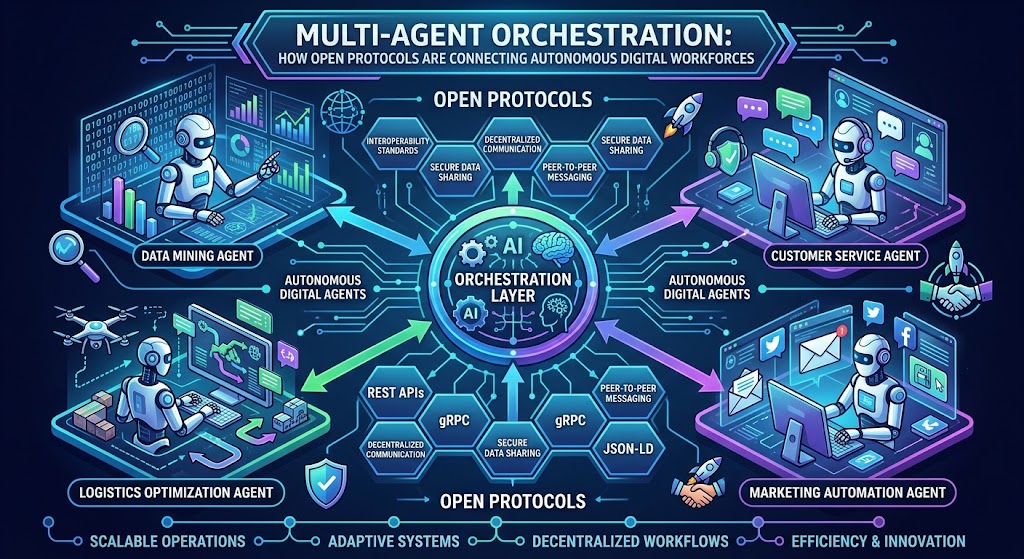
When enterprises have first adopted enterprise AI, the prevailing approach involved building single-agent digital assistants. Companies would develop localized bots for customer service, code generation, document processing, etc. While such single-agent approaches can be effective for narrow tasks, they provide very limited value when it comes to end-to-end processes. Real-world business operations are multi-step and involve multiple departments and software systems. Attempting to rely on one language model with one system prompt and one set of tools for complex operations will lead to inevitable inaccuracies and failures.
To address this challenge, enterprise AI development has moved towards Multi-Agent Systems (MAS). Rather than relying on one all-powerful model, companies are beginning to adopt orchestration of multiple narrowly-tuned digital workers. Within a MAS architecture, individual agents can be responsible for different aspects of the same business process. Some examples include parsing contracts, executing database queries, or performing financial audits. This approach provides dramatically better accuracy and efficiency compared to the single-agent status quo.
How do autonomous agents communicate?
When it comes to MAS, the question of orchestration is paramount. To execute complex operations, multiple agents must be combined into an end-to-end process. However, unless they are able to communicate with each other effectively, such a system will produce worse results than a single model. Thus, when constructing a MAS, orchestrators must be able to issue instructions, distribute subtasks, and receive results from different agents. The same goes for the agents which are being orchestrated: they must be able to receive instructions and report their status and results to the orchestrator.
These inter-agent communication rules are best formalized in the form of open standards. The most widespread standard for inter-agent communication is Agent-to-Agent (A2A). A2A protocol allows for interoperability between different AI agents.
An Agent Card is a machine-readable document which describes the capabilities of a given agent, what parameters it accepts, what results it returns, what security standards it employs, and other relevant information. Thus, when an orchestrator attempts to utilize an agent, it will first read its Agent Card, verify that it possesses the necessary capabilities, and provide it with a request in the specified format.
Turning multi-agent orchestration into a competitive advantage
Standardized orchestration opens up new possibilities for digital transformation across an entire enterprise. Let’s imagine a scenario where an enterprise needs to purchase a specialized set of equipment. In a conventional setting, a purchase would have to be discussed between the procurement team and representatives of the supplying company. The purchase decision would have to be reviewed by the finance department, while the legal team would have to review the contract terms. Now imagine if that entire process could be automated.
When an orchestrator agent is tasked with sourcing new equipment, it can delegate this task to multiple agents. One agent can be tasked with reviewing the supply contract, another agent can analyze the financial terms of the deal, and a third agent can negotiate delivery timelines with the counterparty’s logistics agent directly over A2A protocol. Individual agents can work independently and only share information relevant to their tasks. In practice, such a system would allow for dramatically shorter time-to-delivery while retaining full auditability and control. For enterprises which want to transform their operations in a similar vein, developing custom AI agents can be a great way to begin. By automating multi-step processes across various departments, companies can obtain substantial efficiency gains.
Governance of distributed digital workforces
When deploying distributed AI labor, enterprises should be aware of additional governance challenges which arise when multiple autonomous agents are utilized. When multiple AI models are involved in processing a request, additional precautions must be taken to ensure that no unnecessary information is shared between them. At the same time, orchestration agents should only use workers with the necessary privileges and should be prohibited from attempting to utilize privileged workers directly. If an unauthorized worker agent attempts to execute a high-value task, it may be able to exfiltrate data or modify the database directly. To prevent such breaches, enterprises should utilize real-time monitoring proxies for all communications between their own agents and external workers. Additionally, orchestration should be limited to only the minimum depth of execution required for a given task. By implementing such restrictions, enterprises can utilize third-party workers while minimizing potential attack surfaces. In most cases, utilizing verified identities and requiring human approval for all high-value operations would be the safest option. When it comes to governance of digital workforces, experience shows that perimeter security is much more valuable than post-exploitation response. By partnering with a reliable provider for enterprise AI Agent development, organizations can implement hardened default configurations for their orchestration infrastructure.
As the industry moves towards open inter-agent protocols, enterprise software will evolve from single-agent tools towards multi-agent orchestration. Organizations which utilize such orchestration platforms will be able to scale their use of enterprise AI both in terms of volume and complexity.
Contributed by Guestposts.biz
Further Reading: Cyber Gear Thought Leadership Series







Comments are closed.