
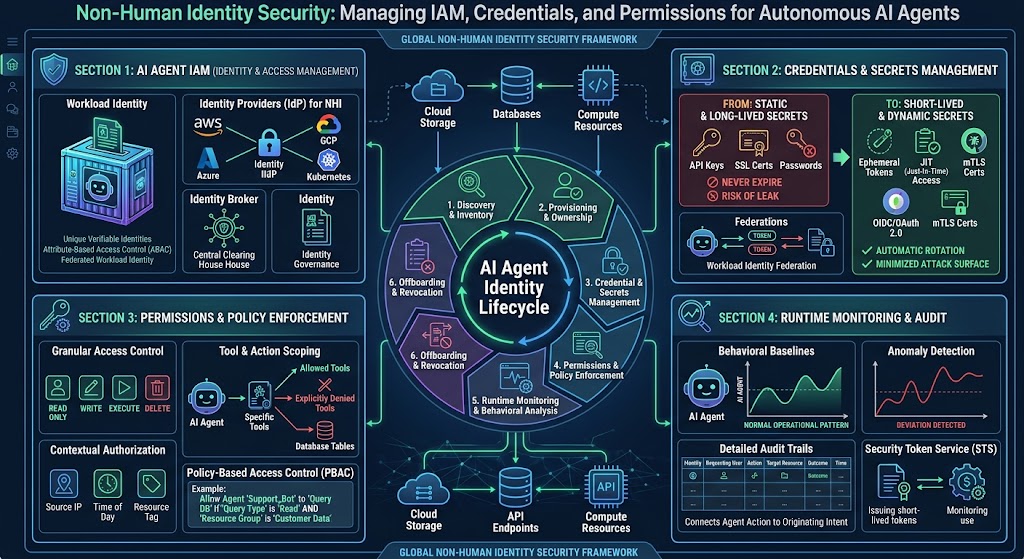
Over the past decade, enterprise Identity and Access Management (IAM) frameworks were built upon modeling human user behaviors. IT security departments deployed single sign-on (SSO) portals, enforced multi-factor authentication (MFA), and established role-based access control (RBAC) policies that ensured human employees only accessed software applications needed for their specific job functions.
The rise of autonomous AI agents is rendering human-centric security models obsolete. As enterprises deploy digital workers to perform tasks across enterprise databases, cloud platforms and third party SaaS tools — it is no longer a human employee behind the corporate firewall that requires access to enterprise assets. Instead, it is an autonomous software agent making decisions and executing tasks at machine speed. This shift is causing an explosion of Non-Human Identities (NHIs) that necessitates a complete revamp of enterprise cybersecurity architecture.
The Risk Surface of Over-Privileged AI Agents
Securing credentials of autonomous agents poses unique security risks than traditional static service accounts. In legacy automation systems, a service account would be used to run a pre-scripted set of jobs — which made its access patterns relatively predictable. Autonomous AI agents take dynamic, non-linear decisions to complete tasks — based on business logic relevant to their functional domain.
If an enterprise were to provide broad API credentials or master database access keys to an agent runtime that makes execution decisions, significant security risks would be introduced. An attacker could exploit an indirect prompt injection vulnerability within an untrusted document and persuade an over-privileged agent to exfiltrate sensitive customer records or illicitly write to the database. Similarly, static secret keys embedded within agent runtime environments could be extracted if an execution container were to get compromised.
Implementing Zero-Trust Architectures for Non-Human Identities
To defend against credential theft and privilege escalation attacks, enterprise IT security teams need to enforce zero-trust principles to secure autonomous agentic networks. Within a zero-trust identity framework, software agents should never be implicitly trusted — whether they operate inside local network perimeters or cloud environments.
Key security mechanisms for securing agent identities are as follows:
Just-In-Time (JIT) Credential Provisioning: Agents should not retain long-lived master API keys. Instead, identity managers should issue short-lived, ephemeral access tokens that expire as soon as the task is completed
Granular Least-Privilege Scoping: Access permissions should be restricted to sub-set of resources required for a specific sub-task. An agent required to access inventory data should not have any permissions to access billing ledgers or employee records
Hardware-Backed Secret Vaulting: Private transaction keys and cryptographic credentials should be encrypted and secured inside Hardware Security Modules or secure enclaves — to prevent model inversion attacks that extract secrets from context windows
Machine Behavioral Analytics: Security systems should monitor access velocity and payload schemas of agents, and automatically revoke credentials if an agent attempts to execute anomalous tool chains
Enterprises that wish to secure their machine identities can work with custom AI agent security architects to configure zero-trust identity pipelines. Cryptographic Delegation Tracing and Verifiable Intent
Securing agent delegation becomes significantly more difficult, when multi-agent systems need to delegate sub-tasks across organizational boundaries. If an internal procurement agent were to delegate a sourcing request to supplier agent, security teams must be able to trace such delegation flows end-to-end.
Modern agentic IAM frameworks employ cryptographic delegation proofs and Verifiable Intent credentials to secure such flows. When an agent forwards a delegated task, it signs a time-bound cryptographic token that defines the sub-agent’s allowed scope, maximum transaction value and an expiration timestamp. If a sub-agent attempted to operate outside the scope of its delegated tasks, remote systems would automatically reject such requests. Implementing cryptographically audited identity frameworks with enterprise AI Agent frameworks ensures that agent delegation remains transparent and traceable.
As non-human identities outnumber human users across enterprise networks, securing autonomous digital workers will become a critical pillar of corporate cybersecurity. Enterprises that implement zero-trust identity management for AI agents today, will scale autonomous operations safely, without exposing their core systems to compromise.
Contributed by GuestPosts.biz
Further Reading: Cyber Gear Thought Leadership Series







No comments yet.