
Regulatory compliance has become one of the most resource-draining problems for corporations operating at a global level. At a fundamental level, financial institutions, healthcare groups, energy companies, and technology firms must adhere to continuously evolving international regulations, including GDPR, HIPAA, the EU AI Act, SOC 2, and industry-specific guidelines. Navigating this regulatory environment requires tracking legislative changes, auditing thousands of vendor contracts, examining internal operations, and generating regulatory documentation for compliance authorities.
A traditional RegTech software focused on manual auditing, keyword-based contract discovery, and document storage and retrieval. When new regulations arise or current law undergoes revisions, an enterprise’s legal and compliance teams will spend months sifting through its contract library and internal operations for regulatory inconsistencies.
Enterprises looking to accelerate regulatory compliance are turning to autonomous RegTech agents.
How RegTech Compliance Agents Automate Regulatory Workflows
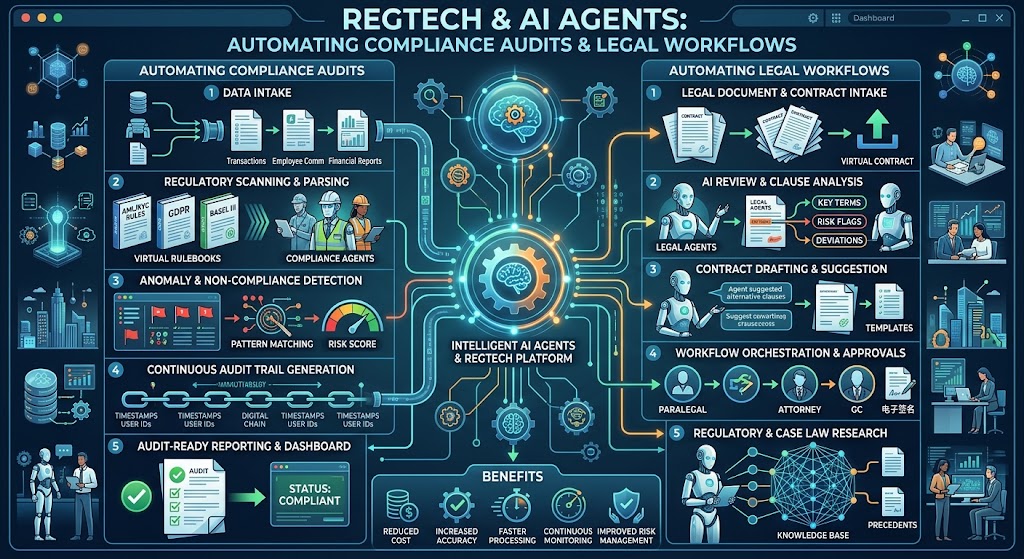
Regulatory compliance agents act as ever-learning digital auditors that analyze enterprise documents, systems, and processes to check for legal and regulatory conformance and perform audits automatically. To achieve end-to-end automation, specialized compliance agents are typically trained with regulatory expertise, document parsing and extraction rules, and internal system telemetry analysis rules.
The key functions performed by RegTech agents in a corporate environment include:
• Automated Contract Regulatory Auditing: Compliance agents scan a company’s commercial contracts for regulatory inconsistencies, liabilities, and gaps in data privacy and other areas of concern.
• Regulatory Monitoring and Alerting: RegTech agents process continuous streams of new regulatory information and compare them to a firm’s internal policy and contractual commitments, identifying problem areas and suggesting policy or procedural changes.
• Continuous System Telemetry Auditing: Many regulations require organizations to demonstrate that their data processing operations and financial systems are formally audited and follow appropriate security standards. Compliance agents can routinely scan enterprise software and data logs for internal control violations.
• Automated Generation of Audit Documentation: Regulatory agents can compile complete sets of audit documentation, including all supporting evidence, with a few keystrokes.
Example: How Companies Can Use RegTech Agents for GDPR and the EU AI Act
The use case for RegTech agents in automating regulatory compliance is best demonstrated by automated privacy and AI safety audits. If a firm makes any significant changes to its customer data portal or begins using a new internal AI application, an autonomous compliance agent can quickly analyze the modifications for regulatory violations.
The agent will scan the software’s data access infrastructure to determine if any sensitive personal data may be processed inconsistently with the GDPR’s privacy principles and the EU AI Act’s safety requirements. At the same time, the regulatory agent would flag any weaknesses in the application’s data encryption infrastructure. In practice, such findings would allow legal teams to update their policy documentation and make the appropriate adjustments in the revised application code. Such an approach to regulatory compliance could reduce an enterprise’s billable hours for legal auditing by up to 80%. Companies that want to stay ahead of the regulatory curve should consider working with expert AI agent development services to create a digital auditor that serves their needs.
Governance, Verifiability, and Zero-Hallucination Legal Controls
When building regulatory compliance agents, enterprises must emphasize zero hallucination and implement appropriate guardrails to reduce legal risk. A hallucinating legal AI agent that implements incorrect regulatory modifications poses a significant risk of litigation and regulatory penalty.
To prevent problem scenarios, RegTech developers should equip compliance agents with zero hallucination copilots that operate under strict retrieval augmentation generation (RAG) guardrails and only produce verifiable information with proper legal citations. One practical approach to reducing hallucination risk is to ensure that enterprise RegTech agents operate with restricted large language models (LLMs) with limited output capabilities, mainly append-only operations. Finally, to ensure verifiability and reduce legal risk, regulatory agents should be programmed to only perform actions with human legal operator assistance and maintain extensive audit trails of all actions taken.
As regulations grow more comprehensive and detailed, manual regulatory compliance audits will become unviable, and organizations will be forced to adopt alternative methods of achieving continuous regulatory compliance. Enterprises that embrace autonomous RegTech agents can drastically reduce their compliance costs while limiting legal exposure and ensuring they are always audit-ready.
Contributed by GuestPosts.biz
Further Reading: Cyber Gear Thought Leadership Series







No comments yet.